India has over 150 million farming households (Source: NABARD All India Rural Financial Inclusion Survey, 2022), and the vast majority of them use WhatsApp daily. Yet agricultural commerce still runs on middlemen, physical mandi visits, and word-of-mouth pricing. WhatsApp is bridging this gap by becoming the digital backbone for everything from mandi price discovery to input ordering and crop selling.
Why Is WhatsApp Becoming Essential for Indian Agriculture?
The Indian farmer's relationship with technology has evolved dramatically. Affordable smartphones and cheap data plans mean that even small and marginal farmers in villages across Madhya Pradesh, Uttar Pradesh, and Karnataka are active WhatsApp users. They share crop photos, discuss techniques in farmer groups, and increasingly expect to conduct business through the app.
Traditional agricultural commerce suffers from information asymmetry. A tomato farmer in Nashik does not know the price his produce commands in Mumbai's Vashi mandi until a middleman tells him — often quoting below market rates. WhatsApp eliminates this gap instantly.
The advantages for agriculture are clear:
- Language accessibility: WhatsApp supports Hindi, Marathi, Tamil, Telugu, Kannada, and every major Indian language through voice notes and text
- Low bandwidth requirements: Price updates and text messages work even on slow rural networks
- Trust through familiarity: Farmers already use WhatsApp for personal communication, so there is no adoption barrier
- Voice note support: Farmers who are less comfortable typing can communicate entirely through voice messages
Agri-businesses using WatEase's agriculture solutions can typically reach far more farmers than traditional field sales teams at a fraction of the cost.
How Can Agri-Businesses Deliver Mandi Prices Through WhatsApp?
Real-time mandi price information is the most valuable service any agri-business can offer to farmers. It builds trust, drives engagement, and creates a captive audience for other services.
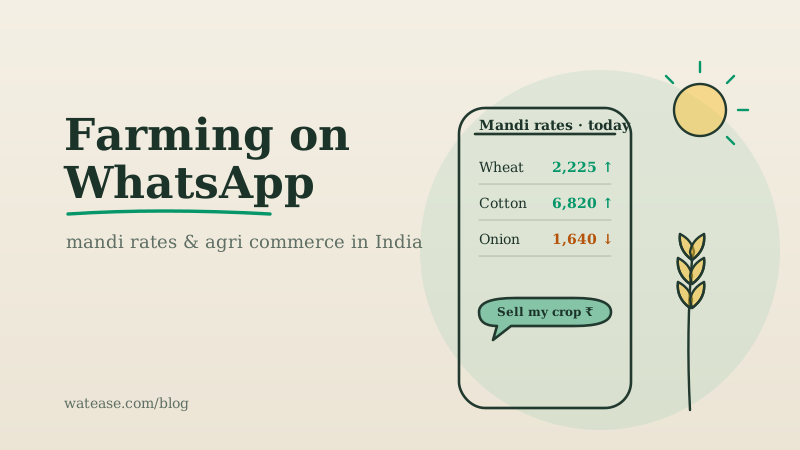
Daily price broadcasts: Send morning updates covering prices of key crops at nearby mandis. A wheat farmer in Haryana wants to know prices at Karnal, Ambala, and Hisar mandis before deciding where to sell. Format prices clearly — crop name, mandi name, minimum price, maximum price, and modal price.
Crop-specific subscriptions: Let farmers subscribe to prices for the crops they grow. A sugarcane farmer does not need onion prices. Segmented broadcasts ensure relevance and prevent message fatigue.
Price comparison alerts: When prices at a particular mandi spike above the weekly average, send targeted alerts to farmers growing that crop within transport distance. These alerts directly increase farmer income by helping them sell at peak prices.
Historical trends: Share weekly or monthly price trend summaries that help farmers make planting decisions. If soybean prices have been climbing for three consecutive months, that information influences next season's crop choice.
An agricultural input company in Maharashtra implemented daily mandi price broadcasts through WatEase and grew their farmer subscriber base substantially over six months (illustrative WatEase merchant example — internal benchmark, methodology on request, as of June 2026). These farmers then became customers for seeds, fertilisers, and crop advisory services.
How Does Seed and Fertiliser Ordering Work on WhatsApp?
Agricultural input ordering through WhatsApp removes the need for farmers to travel to town, wait at dealerships, and carry heavy bags back to their fields. It is especially valuable during peak sowing seasons when time is critical.
Product catalog with regional recommendations: Build a WhatsApp catalog organised by crop and season. For kharif season, feature paddy seeds, DAP fertiliser, and relevant pesticides. Include recommendations specific to the local soil and climate conditions.
Simple ordering flow: Keep it friction-free. The farmer sends "1" for seeds, "2" for fertiliser, "3" for pesticides. Then selects the specific product and quantity. An automated order confirmation follows immediately with the total amount and expected delivery date.
UPI payment integration: Generate payment links within the WhatsApp conversation. Farmers can pay using any UPI app — PhonePe, Google Pay, or Paytm — without leaving the chat. For larger orders, offer cash-on-delivery or credit terms documented in the conversation.
Delivery coordination: Send dispatch notifications, tracking updates, and delivery confirmations. For bulk orders, coordinate delivery timing with the farmer to ensure someone is available to receive the goods.
Reorder reminders: Based on purchase history and crop cycles, send timely reminders when farmers are likely to need their next round of inputs. A farmer who bought paddy seeds in June will need fertiliser in July and pesticide in August.
Agri-input dealers who adopt WhatsApp ordering through WatEase's commerce tools often report a meaningful reduction in order processing time and fewer returns due to clearer product communication.
Run your business on WhatsApp with WatEase
Set up in minutes with guided onboarding. 0% markup on WhatsApp messages.
Get started →Want a plan sized to you? Get a quote
How Are Weather Alerts and Crop Advisories Delivered via WhatsApp?
Timely weather information can mean the difference between a profitable harvest and a devastating loss. WhatsApp delivers this critical information directly to the farmer's pocket.
Hyperlocal weather forecasts: Partner with weather data providers to send block-level or taluka-level forecasts. A generic state-level forecast is useless — a farmer in Vidarbha needs to know if rain is expected in his specific taluka tomorrow.
Severe weather warnings: When cyclones, unseasonal rain, or frost are predicted, send urgent alerts with specific protective actions. "Heavy rain expected in Sangli district next 48 hours. Harvest ripe grapes immediately. Do not spray pesticides." These actionable alerts save crops and livelihoods.
Crop stage advisories: Based on sowing date data, send stage-specific advisories. If a farmer planted cotton 45 days ago, send guidance on that specific growth stage — pest watch, water management, and nutrient requirements.
Pest and disease alerts: When pest outbreaks are reported in a district, alert farmers in neighbouring areas with identification photos, treatment recommendations, and input purchase links. Connecting the advisory directly to a purchase option through WatEase's integrated catalog creates a seamless experience.
Harvest timing guidance: Combine weather forecasts with crop maturity data to recommend optimal harvest windows. "Your wheat crop is likely ready for harvest. Clear weather expected for next 5 days — ideal for cutting and drying."
Farmer producer organisations (FPOs) using WhatsApp advisories often see improved crop outcomes among their member farmers (directional finding from WatEase FPO pilots — internal benchmark, methodology on request, 2025), which they attribute to timely information delivery.
The economics also tend to stack up favourably against legacy outreach channels. The figures below are directional WatEase planning estimates (internal benchmark, methodology on request, as of June 2026) and will vary by region, message type, and Meta pricing — treat them as relative comparisons rather than guaranteed numbers:
| Channel | Indicative reach per ₹1,000 spend | Typical latency for urgent alert | Two-way support? |
|---|---|---|---|
| SMS gateway | Lower | A few minutes | No |
| IVR / voice call | Lowest | Tens of minutes | Limited |
| Field extension officer | Very limited (manual) | Same-day to next-day | Yes |
| WhatsApp Business API (via WatEase) | Highest of the four | Often under a minute | Yes (text + voice notes) |
The combination of speed, reach, and two-way conversation is what makes WhatsApp uniquely suited to agri-extension at scale. The WhatsApp Business Platform documentation covers the underlying API capabilities in detail.
How Can Government Scheme Information Reach Farmers Through WhatsApp?
Despite dozens of beneficial schemes like PM-KISAN, PM Fasal Bima Yojana, and Kisan Credit Card, most farmers remain unaware of schemes they are eligible for. WhatsApp closes this awareness gap effectively.
Scheme eligibility notifications: When new schemes launch or application windows open, send targeted notifications to eligible farmers. Include the scheme name, benefits, eligibility criteria, required documents, and application deadline in a clear format.
Application assistance: Guide farmers through application processes step by step within WhatsApp. Share screenshots of online portals, explain form fields in local language, and help collect required documents by asking farmers to photograph and send Aadhaar cards, land records, and bank passbooks.
Status tracking: After applications are submitted, send periodic status updates. "Your PM-KISAN application has been approved. First installment of ₹2,000 will be credited by 15th of next month."
Document reminders: Send reminders before deadlines for crop insurance premium payments, KCC renewals, and soil health card applications. Many farmers miss benefits simply because they forget deadlines.
Agricultural organisations and government bodies can use WatEase's automation to manage scheme communication for lakhs of farmers with minimal manual effort. Tell us your use case at WatEase pricing and we quote a plan that fits.
How Does WhatsApp Enable Direct Farmer-to-Buyer Connections?
The most transformative potential of WhatsApp in agriculture is disintermediation — connecting farmers directly with buyers, retailers, processors, and exporters.
Produce listing by farmers: Farmers share photos of their harvest-ready crops with details — crop variety, estimated quantity, location, and expected harvest date. This information is catalogued and shared with relevant buyers.
Buyer requirements broadcast: When a buyer needs 10 tonnes of grade-A onions, broadcast the requirement to onion farmers in relevant districts. Interested farmers respond with availability and price expectations.
Quality verification: Buyers can request specific photos or videos to assess crop quality before committing. A rice mill owner can ask a farmer to send close-up photos of grain size and moisture meter readings.
Price negotiation: Unlike mandi auctions where farmers have no bargaining power, WhatsApp enables one-on-one negotiation. Farmers can compare offers from multiple buyers and choose the best price.
Transport coordination: Once a deal is confirmed, coordinate pickup logistics through the same conversation. Share vehicle details, loading time, and weighbridge locations.
FPOs and agri-tech companies facilitating these connections through WatEase report that farmers can receive meaningfully higher prices compared to traditional mandi sales, primarily because middleman margins are eliminated.
What Should Agri-Businesses Consider Before Launching WhatsApp Services?
Launching agricultural WhatsApp services requires understanding the unique needs and constraints of the farming community.
Voice-first design: Many farmers are more comfortable with voice notes than text. Design your flows to accept voice inputs and send voice responses where possible. A farmer describing a pest problem through a voice note is far more natural than typing.
Timing matters: Farmers are in their fields early morning and late afternoon. Schedule broadcasts between 7-8 AM and 6-7 PM when they are most likely to check their phones.
Regional language content: Do not default to English or even Hindi. Create content in the dominant language of your target region. A farmer in Tamil Nadu expects communication in Tamil.
Start with value, sell later: Lead with free mandi prices and weather alerts. Once farmers trust your channel, introduce input sales and advisory services. The trust-first approach is essential in rural India.
Measure impact in farmer terms: Track metrics that matter to farmers — did they get better prices, did they save on inputs, did they avoid crop losses. These outcomes drive word-of-mouth referrals that grow your farmer network organically.
WhatsApp is not just another marketing channel for agriculture — it is becoming essential infrastructure for modern Indian farming. By connecting farmers to markets, information, and inputs, agri-businesses can build sustainable operations while genuinely improving farmer livelihoods. Get started with WatEase to explore how WhatsApp can transform your agricultural business.