The honest answer to "how much does it cost to start an online store in India?" is: anywhere from ₹0 to ₹30,000+ — and the gap is almost entirely about which route you choose. This 2026 breakdown puts real rupee figures against every option and every fee, including the hidden ones, so you can start with eyes open. For the step-by-step of the cheapest route, pair this with our guide to creating a free online store in India.
What Does It Actually Cost to Start an Online Store in India?
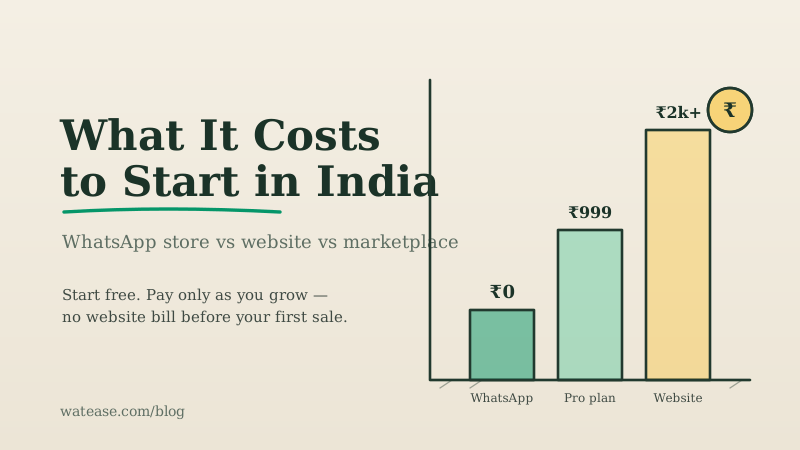
Across the three main routes, your starting cost ranges from nothing to several thousand rupees a month. The difference is upfront investment versus commission, and how much traffic you already have.
| Route | Upfront / monthly cost | Per-sale cost | Time to launch |
|---|---|---|---|
| WhatsApp store (WatEase) | On request | ~0% on UPI | Under 5 minutes |
| Self-built website | A few thousand rupees/month (varies widely) | ~2% gateway on cards (see gateway pricing) | 1–2 weeks |
| Marketplace (Amazon/Flipkart/Meesho) | Free to list | Per-sale commission, commonly 5–25% (see seller fee schedule) | 1–3 days |
For a first-time seller without an existing audience, the WhatsApp store is the lowest-risk start: your costs stay low and predictable, and you keep your margin. A marketplace makes sense if you need instant traffic and can absorb commission; a website makes sense once you have demand to drive to it.
What Are the Cost Layers of a WhatsApp Store?
A WhatsApp store has three predictable cost layers, and for low volume the usage-based layers stay close to zero. Understanding them prevents "free" from surprising you later.
| Layer | What it covers | Typical cost |
|---|---|---|
| Platform subscription | Catalog, orders, automation | On request, with a plan customised to your business |
| WhatsApp message fees | Meta's per-message charge | ~₹0.115 utility, ~₹0.8631 marketing (as of September 2026) |
| Payment processing | Fee on each sale | UPI ~0%; Razorpay/PhonePe/Paytm ~2% on cards (see each gateway's pricing) |
A small store taking mostly UPI orders keeps its running costs low, since UPI carries no MDR and WhatsApp messages attract only Meta's per-message fee. Your actual cost depends on your message and order volume — model your own messaging bill with the conversation cost calculator. The platform you choose matters here too — see WatEase's WhatsApp commerce platform, or compare options in our best WhatsApp commerce platforms in India roundup.
Why Does a Website Cost So Much More to Start?
A website front-loads cost and time before you've earned a single rupee, because you're paying for infrastructure and traffic you have to build yourself.
Typical monthly website costs in India stack up like this:
- Platform subscription — hosted store builders commonly start around ₹2,000/month (check the builder's current pricing)
- Domain — typically a few hundred to ~₹1,000/year
- Theme — free options exist; premium templates can run several thousand rupees one-time
- Apps and plugins — paid add-ons for reviews, shipping, popups, and more can add up each month
- Payment gateway — around 2% per transaction (see the gateway's published pricing)
- Traffic — SEO takes months; ads cost money from day one
That's why a website typically runs a few thousand rupees per month all-in (the exact figure varies a lot by platform and apps), plus a week or two of setup. It earns its place once you have steady demand and want organic discovery — but as a starting point it's expensive. Our WhatsApp vs website comparison covers when each makes sense.
Run your business on WhatsApp with WatEase
Set up in minutes with guided onboarding. 0% markup on WhatsApp messages.
Get started →Want a plan sized to you? Get a quote
What Does a Marketplace Really Cost?
Marketplaces look free because there's no subscription to list — but the commission and fulfilment fees are where the real cost sits, and they recur on every order.
Expect these deductions:
- Commission — varies by category, commonly in the 5–25% range (see each marketplace's published seller fee schedule)
- Closing/collection fees — fixed per-order charges
- Fulfilment and storage — if you use the marketplace's logistics
- Returns — you often bear the cost on customer returns
- GST — a GSTIN is required to sell many categories
The trade-off is real traffic versus thin margins and no ownership of the customer. Many Indian sellers use marketplaces for discovery and a WhatsApp store for repeat and high-margin orders, keeping the relationship — and the data — on their own platform.
What Hidden Costs Catch Sellers Off Guard?
The fees that hurt are the ones not on the headline price. Budget for these from the start so they don't erode your margin unexpectedly.
- Payment-gateway fees — around 2% on cards (see your gateway's pricing) adds up; default to UPI to avoid most of it
- Message fees — predictable but real from the first WhatsApp message
- GST — once registered, you charge and remit it; price it in
- Product photography — even phone photos take time; clear images generally help shoppers buy with confidence
- Returns and refunds — logistics and restocking, especially on fashion and apparel
- Renewals and app fees — on websites, these creep up quietly each month
The single biggest lever is your default payment method: choosing UPI (~0% MDR) over cards (around 2% per the gateway's pricing) directly protects your margin on every order. See the full fee comparison in our payment collection guide.
How Should You Budget as You Grow?
Spend in step with revenue, not ahead of it. The lowest-risk path is to start lean, validate that people actually buy, and reinvest profit into the next stage.
A sensible progression for an Indian seller:
- Validate (₹0): test demand with WhatsApp's free Business App or your existing contacts before committing to a platform.
- Launch (priced on request): tell us your use case and we quote a WatEase plan that fits, with a full catalog, automation, CRM, and higher conversation limits.
- Acquire (variable): add click-to-WhatsApp ads or SEO content to generate new demand.
- Expand (priced on request): add AI agents, attribution, and advanced analytics to your plan as your business grows — funded by revenue, not savings.
This way your costs only rise as your sales do. To start at the lean end of that curve today, create your WatEase account and tell us your use case on the pricing page so we can quote a plan that fits. For the wider market context, the official Meta WhatsApp Business Platform pricing explains the conversation-fee model in detail.