Healthcare providers across India are embracing WhatsApp to communicate with patients more effectively, reduce no-shows, and streamline administrative workflows. However, healthcare communication carries unique compliance responsibilities that every provider must understand before implementation. This guide covers everything Indian healthcare organizations need to know.
Why Is WhatsApp Becoming Essential for Indian Healthcare Providers?
WhatsApp is becoming essential because Indian patients overwhelmingly prefer it as their communication channel, and providers who adopt it see measurable improvements in patient engagement, appointment adherence, and operational efficiency.
Consider the current reality of healthcare communication in India:
- Phone calls go unanswered: a large share of appointment reminder calls are missed or ignored
- SMS has low engagement: Generic SMS reminders feel impersonal and are often filtered as spam
- Email is irrelevant: A large portion of Indian patients, especially in tier-2/3 cities, rarely check email
- WhatsApp is universal: With 500+ million Indian users (Source: Meta India, 2025), WhatsApp is the one channel patients actively monitor
Healthcare organizations using WhatsApp Business API through platforms like WatEase commonly report directional improvements like these (illustrative of WatEase merchant observations — internal benchmark, methodology on request, as of June 2026; your results will vary):
- a meaningful reduction in appointment no-shows
- faster patient response times
- lower front-desk call volume
- high patient satisfaction with communication quality
From single-doctor clinics to multi-specialty hospitals, WhatsApp is transforming how Indian healthcare delivers patient experiences.
How Should Healthcare Providers Handle Patient Data Compliance on WhatsApp?
Healthcare providers must treat WhatsApp communication as a regulated activity under Indian law, implementing specific safeguards to protect patient data and maintain trust.
The legal framework:
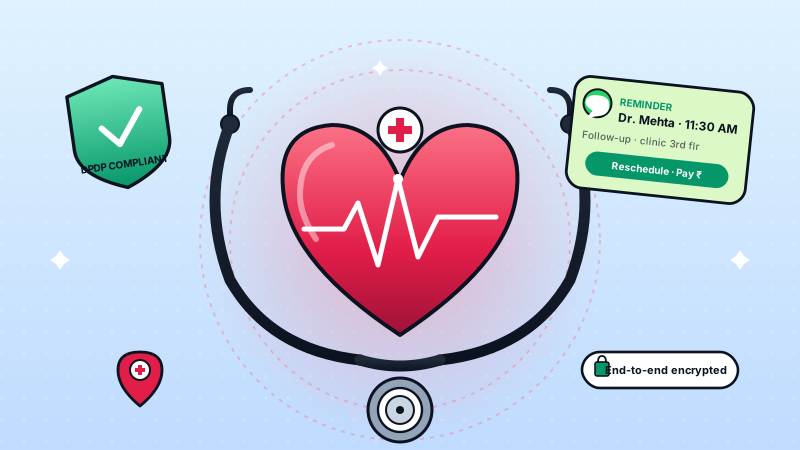
India's Digital Personal Data Protection (DPDP) Act classifies health data as sensitive personal data requiring heightened protection. Healthcare providers must comply with these key requirements:
- Explicit consent: Obtain written or digital consent before sending any health-related messages. A simple opt-in message is not sufficient — patients must understand what data will be shared and how
- Purpose limitation: Only send messages related to the purpose for which consent was obtained. If a patient consented to appointment reminders, do not send promotional messages about cosmetic procedures
- Data minimization: Share only the minimum necessary information. An appointment reminder should include date, time, and doctor name — not the diagnosis or treatment details
- Access controls: Limit who within your organization can view and respond to patient WhatsApp messages
Practical compliance steps:
- Use WhatsApp Business API (not the regular WhatsApp Business app) for full audit trails, retention controls, and a defensible record of consent — note that the API channel is server-mediated by Meta, not end-to-end encrypted, so it is the audit and consent posture that does the compliance work, not the transport encryption
- Implement role-based access so only authorized staff handle patient messages
- Never share patient reports, test results, or prescriptions in group chats
- Maintain message logs for a minimum of 3 years as required by medical record regulations
- Create a data breach response plan specific to WhatsApp communications
WatEase's healthcare solution includes built-in compliance templates, consent management, and audit logging designed specifically for Indian healthcare regulations.
What Types of Messages Can Healthcare Providers Send on WhatsApp?
Healthcare providers can send a wide range of messages on WhatsApp, from appointment reminders to health education, as long as each message type has appropriate patient consent and follows compliance guidelines.
Appointment management (highest impact):
- Appointment confirmations with date, time, doctor, and location details
- Reminder sequences at 48 hours, 24 hours, and 2 hours before the appointment
- Easy reschedule and cancellation buttons that reduce front-desk workload
- Post-visit follow-up messages with care instructions
Administrative communications:
- Registration and onboarding information for new patients
- Insurance and billing updates
- Document collection requests (ID proof, previous reports)
- Feedback and satisfaction surveys after visits
- Payment reminders and UPI payment links for outstanding bills
Clinical communications (with explicit consent):
- Lab report availability notifications (not the reports themselves in the message)
- Medication reminders for chronic disease management
- Pre-procedure preparation instructions
- Post-operative care guidelines
- Vaccination schedules and reminders
Health education and wellness:
- Seasonal health advisories (dengue prevention, heat stroke awareness)
- Chronic disease management tips for diabetic or hypertensive patients
- Preventive health checkup reminders based on age and risk factors
- General wellness content that adds value without being promotional
The key principle is that every message should serve the patient's health interest, not the provider's commercial interest. Providers who follow this approach using automated workflows tend to maintain high opt-in rates.
Run your business on WhatsApp with WatEase
Set up in minutes with guided onboarding. 0% markup on WhatsApp messages.
Get started →Want a plan sized to you? Get a quote
How Can Hospitals Reduce No-Shows with WhatsApp Appointment Reminders?
Hospitals can meaningfully reduce no-shows by implementing a structured WhatsApp reminder system that combines timely notifications with frictionless rescheduling options.
The most effective reminder sequence for Indian healthcare settings:
Reminder 1 — 48 hours before: Send a detailed confirmation with appointment date, time, doctor name, clinic address (with Google Maps link), and any preparation instructions (fasting requirements, documents to bring). Include "Confirm" and "Reschedule" buttons.
Reminder 2 — 24 hours before: A shorter reminder for patients who confirmed. For those who did not respond, include a "Call me to confirm" button that triggers a callback from the front desk.
Reminder 3 — 2 hours before: A brief reminder with directions and expected wait time. This is especially effective for hospitals in congested areas where patients need to plan travel time.
Post-no-show follow-up: If a patient misses their appointment, send a non-judgmental message within 2 hours offering to reschedule. Include available slots for the next 3 days. This often recovers a meaningful portion of no-shows.
Advanced strategies:
- Send reminders in the patient's preferred language (Hindi, Tamil, Telugu, Bengali, etc.)
- For high-value appointments (surgeries, specialist consultations), add a phone call backup
- Track no-show patterns by time slot, doctor, and day of the week to optimize scheduling
- Offer waitlist notifications to fill cancelled slots automatically
In one WatEase merchant example, a multi-specialty hospital in Pune implemented this exact framework and reported reducing its no-show rate from 28% to 12% within three months, recovering an estimated ₹15 lakhs in monthly revenue (single-customer result reported to WatEase — internal benchmark, methodology on request, as of June 2026; individual results will vary).
How Should Pharmacies and Diagnostic Labs Use WhatsApp?
Pharmacies and diagnostic labs have unique WhatsApp use cases that focus on order management, report delivery, and medication adherence — each requiring specific compliance considerations.
For pharmacies:
- Prescription collection: Patients photograph and send prescriptions via WhatsApp for the pharmacy to prepare orders in advance, which can meaningfully reduce wait times
- Medicine availability checks: Automated responses to check if specific medicines are in stock
- Refill reminders: For patients on chronic medications, send timely refill reminders before their current supply runs out
- Generic alternatives: When branded medicines are unavailable, suggest equivalent generics with price comparisons
- Home delivery coordination: Order confirmation, delivery tracking, and payment through a single WhatsApp conversation
For diagnostic labs:
- Test booking: Allow patients to browse available tests, check prices, and book appointments through WhatsApp
- Sample collection scheduling: Coordinate home sample collection with preferred time slots
- Report notifications: Notify patients when reports are ready with a secure link to download (never send reports directly in the chat)
- Health package promotions: Send personalized health checkup recommendations based on age, gender, and previous tests
Compliance considerations specific to pharmacies and labs:
- Never display prescription details in message previews
- Use secure links with OTP verification for report access
- Maintain prescription records as required by the Drugs and Cosmetics Act
- Ensure lab report links expire after a reasonable period (7-30 days)
How Do You Get Started with WhatsApp for Your Healthcare Practice?
Getting started requires selecting the right platform, setting up compliant workflows, and training your staff to handle patient communications professionally.
Step 1: Choose a compliant platform. Select a WhatsApp Business API provider that understands Indian healthcare regulations. WatEase offers healthcare-specific templates, consent management, and DPDP-compliant data handling built into the platform.
Step 2: Set up consent collection. Create a digital consent form that patients sign during registration. The form should clearly explain what messages they will receive and how their data will be protected. Make opt-out easy and immediate.
Step 3: Build your message templates. WhatsApp Business API requires pre-approved message templates for outbound messages. Work with your platform provider to create templates for appointment reminders, follow-ups, and administrative communications.
Step 4: Train your team. Front-desk staff, nurses, and administrative personnel need clear guidelines on what they can and cannot share on WhatsApp. Create a simple dos-and-don'ts document and conduct a 30-minute training session.
Step 5: Start with appointment reminders. Begin with the highest-impact, lowest-risk use case — appointment reminders. Once you see the reduction in no-shows and positive patient feedback, expand to other communication types.
Register for WatEase to access healthcare-specific onboarding that gets your practice compliant and operational within 48 hours. Tell us your use case on our pricing page and we quote a plan that fits your practice.
Patient communication is the foundation of quality healthcare. WhatsApp gives Indian providers the tools to communicate better, more efficiently, and in full compliance with evolving regulations.
For a quick comparison of communication channels in Indian healthcare:
| Channel | Patient open rate (directional) | Cost per message | Two-way? | Audit trail |
|---|---|---|---|---|
| Phone call (front desk) | Moderate (many unanswered) | ₹4–₹12 (staff time) | Yes | Manual notes |
| SMS reminder | Delivered widely, often unread | Low per-message (carrier-dependent) | Limited | Yes |
| Low in India | Negligible | Yes | Yes | |
| Consumer WhatsApp (informal) | Very high | Free | Yes | None (compliance risk) |
| WhatsApp Business API (via WatEase) | Typically high, usually read quickly | ~₹0.115 utility / ₹0.8631 marketing (Meta per-message rate, as of September 2026 — see Meta's pricing) | Yes | Full, DPDP-grade |
For the underlying API capabilities, see the official WhatsApp Business Platform documentation. The providers who adopt this now will set the standard for patient experience in Indian healthcare.