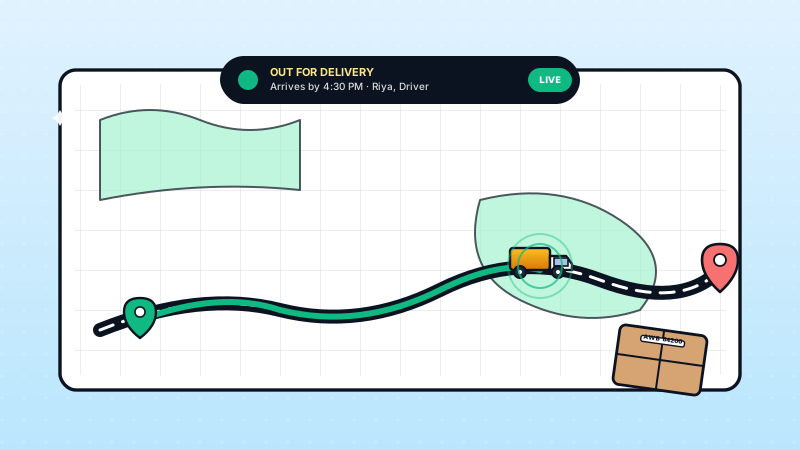
India's logistics industry handles over 4 billion shipments annually (Source: NITI Aayog Logistics Performance Index, 2024), and the single biggest pain point remains communication. Customers want to know where their shipment is. Delivery agents need address clarifications. Operations teams need real-time fleet visibility. WhatsApp solves all three problems on a platform that every stakeholder already uses daily.
Why Are Indian Logistics Companies Adopting WhatsApp for Operations?
The Indian logistics landscape is uniquely challenging. Addresses are often incomplete or inaccurate, customers are frequently unavailable, and last-mile delivery in congested urban areas and remote rural locations demands constant coordination. Traditional communication channels — IVR calls, SMS, and email — simply do not deliver the speed and interactivity that logistics operations require.
WhatsApp transforms logistics communication because:
- Very high message open rate: WhatsApp open rates are widely reported to run far above SMS and email (directional; varies by audience and message type), so tracking updates are actually seen, unlike SMS that often goes unread or lands in spam folders
- Two-way communication: Customers can respond instantly with updated addresses, delivery preferences, or rescheduling requests
- Rich media support: Share maps, photos, delivery receipts, and documents within the same conversation
- Works everywhere: From metropolitan Mumbai to rural Meghalaya, WhatsApp functions reliably on low-bandwidth connections
Logistics companies using WatEase's logistics solutions typically report fewer failed deliveries and a sizeable drop in customer support calls (directional, based on WatEase merchant feedback; outcomes vary by operation) — directly impacting bottom-line profitability.
How Does Real-Time Shipment Tracking Work on WhatsApp?
Proactive shipment tracking through WhatsApp keeps customers informed at every milestone, eliminating the anxiety and frustration that comes with waiting for a delivery without information.
Order confirmation: The moment a shipment is booked, send a WhatsApp message with the tracking number, estimated delivery date, and a brief description of the contents. This sets customer expectations from the start.
Pickup confirmation: When the shipment is picked up from the sender, notify both sender and receiver. Include the pickup time and updated estimated delivery date based on actual pickup timing.
In-transit updates: For long-haul shipments, send daily location updates. "Your shipment has reached the Nagpur hub and is being sorted for onward dispatch to Hyderabad. Expected delivery: 12 April." These updates reassure customers that their shipment is moving.
Out-for-delivery notification: This is the most critical update. Send it early in the morning with a delivery time window. "Your shipment is out for delivery today between 10 AM and 2 PM. Delivery agent: Ramesh (9876XXXXXX). Reply 1 to confirm, 2 to reschedule."
Delivered confirmation: Send a final confirmation with proof of delivery — a photo of the delivered package and, if applicable, receiver details. Close the loop with a satisfaction rating request.
Integrating your TMS with WatEase's API enables fully automated tracking that triggers messages at each status change without any manual intervention.
How Should Logistics Companies Handle Failed Deliveries Through WhatsApp?
Failed deliveries cost the Indian logistics industry thousands of crores annually. Every failed attempt means return trips, rescheduling overhead, and dissatisfied customers. WhatsApp drastically reduces failure rates through proactive communication.
Pre-delivery confirmation: Send a message the evening before delivery asking the customer to confirm availability. "Your shipment arrives tomorrow between 10 AM-2 PM. Will you be available? Reply YES to confirm, NO to reschedule." This single step can prevent a meaningful share of failed attempts.
Real-time address clarification: When a delivery agent cannot locate the address, they can send a WhatsApp message to the customer asking for landmarks or a live GPS location pin. The customer drops a pin, and the agent navigates directly — no phone calls needed, no language barriers.
Instant rescheduling: If the customer is unavailable, offer immediate rescheduling options within WhatsApp. "We attempted delivery but you were unavailable. When should we try again? Reply 1 for tomorrow morning, 2 for tomorrow afternoon, 3 for a specific date."
Alternative delivery options: Offer the customer the choice to redirect the shipment to a neighbour, office address, or nearby pickup point. All coordination happens within the same WhatsApp thread, creating a clear audit trail.
Escalation workflows: If three delivery attempts fail, automatically escalate through WhatsApp with options for customer self-pickup from the nearest hub, along with hub address and operating hours.
Logistics companies implementing failed delivery workflows through WatEase's automation tools often reduce their return-to-origin (RTO) rates meaningfully (directional; actual impact varies by route, product mix, and COD share), saving significant operational costs.
Run your business on WhatsApp with WatEase
Set up in minutes with guided onboarding. 0% markup on WhatsApp messages.
Get started →Want a plan sized to you? Get a quote
How Can Proof of Delivery Be Managed Through WhatsApp?
Proof of delivery (POD) is essential for dispute resolution, invoice reconciliation, and customer trust. WhatsApp provides a richer POD mechanism than traditional paper signatures or basic delivery apps.
Photo proof: Delivery agents photograph the package at the delivery location, showing the package placed at the door or handed to the receiver. This image is sent to the customer and stored in the system simultaneously.
GPS-stamped delivery: Each delivery message includes the GPS coordinates of where the delivery was completed. This prevents disputes about whether the package was delivered to the correct location.
Receiver confirmation: The customer replies to the delivery message confirming receipt. This digital acknowledgment serves as a signed receipt and is timestamped by WhatsApp.
Condition documentation: For fragile or high-value shipments, agents can send photos of the package condition at delivery. If damage is visible, the documentation begins immediately within the same conversation thread.
Centralized POD storage: All delivery photos, GPS data, and customer confirmations are automatically captured and organised by shipment number through WatEase's logistics integration. When a dispute arises weeks later, retrieving the POD takes seconds instead of hours of searching through paper records.
This digital POD system is particularly valuable for B2B logistics where invoice payments are often held pending delivery confirmation.
How Does Fleet Coordination Work Through WhatsApp?
Managing a fleet of delivery vehicles and agents across a city or region requires constant communication. WhatsApp groups and broadcasts, when structured properly, become powerful fleet coordination tools.
Morning dispatch: Send each driver their day's delivery list through WhatsApp — addresses, customer names, contact numbers, and any special instructions. Include an optimized route map image that accounts for traffic patterns and delivery time windows.
Real-time status updates: Drivers update their status after each delivery by sending a quick message or selecting from automated quick reply options. Operations managers get a live view of fleet progress without calling each driver individually.
Issue escalation: When a driver encounters problems — vehicle breakdown, road closure, or customer dispute — they send a message to the operations group. The team responds with solutions immediately, whether that means dispatching a backup vehicle or reassigning remaining deliveries.
Fuel and expense tracking: Drivers photograph fuel receipts, toll slips, and other expense documents and send them through WhatsApp. These are automatically logged against the vehicle and trip for accounts processing.
End-of-day reconciliation: Drivers send their cash collection summary and remaining undelivered shipment details at the end of each shift. This replaces the time-consuming process of drivers returning to the hub for physical reconciliation.
Fleet managers using WatEase's team coordination features can handle more deliveries per driver per day (directional, based on WatEase merchant feedback; results vary) simply through better communication and faster issue resolution.
How Should Returns and Reverse Logistics Be Handled on WhatsApp?
Returns are an inevitable part of logistics, especially with the growth of ecommerce in India. WhatsApp streamlines the reverse logistics process from initiation to refund.
Return request capture: The customer sends a return request through WhatsApp with the order number and reason. Automated workflows validate the return eligibility and confirm or reject the request within minutes.
Pickup scheduling: For approved returns, offer pickup time slots through WhatsApp. "Your return has been approved. When should we pick up the item? Reply 1 for tomorrow 10 AM-1 PM, 2 for tomorrow 2 PM-5 PM, 3 for another date."
Packaging instructions: Send the customer packaging guidelines specific to the product type. For electronics, include instructions about original packaging and accessories. For apparel, a simple polybag suffices. Clear instructions reduce damage during return transit.
Pickup confirmation and tracking: Apply the same tracking workflow used for forward deliveries. Send pickup confirmation, in-transit updates, and warehouse receipt confirmation. The customer knows exactly where their returned item is at all times.
Refund processing: Once the returned item passes quality checks at the warehouse, send a refund initiated message with the expected timeline. Follow up with the actual refund confirmation and transaction reference.
Businesses managing returns through WatEase tend to see noticeably faster return processing times (directional, based on WatEase merchant feedback; results vary) and significantly higher customer satisfaction during what is usually a frustrating experience.
What Should Logistics Companies Know Before Implementing WhatsApp Operations?
Implementing WhatsApp across logistics operations requires careful planning to avoid common pitfalls.
System integration is essential: WhatsApp logistics works best when integrated with your existing TMS, WMS, and CRM. Manual message sending does not scale. Invest in proper API integration from the start through a platform like WatEase.
Template message approval: WhatsApp requires pre-approved templates for proactive messages. Plan your tracking update templates, failed delivery messages, and return workflows in advance. Submit them for approval before launch.
Driver training: Delivery agents need clear guidelines on when and how to use WhatsApp with customers. Define protocols for photo proof, address clarification, and issue escalation. Keep instructions simple — most delivery agents are comfortable with basic WhatsApp functions.
Data privacy compliance: Shipment data contains sensitive information — addresses, phone numbers, and package contents. Ensure your WhatsApp implementation complies with data protection norms and that customer data is handled securely.
Start with one city: Roll out WhatsApp logistics in a single city first. Iron out workflow issues, train your team, and measure impact before expanding to other locations.
WhatsApp is becoming the operating system for Indian logistics. Companies that adopt it early gain a measurable competitive advantage in delivery success rates, customer satisfaction, and operational efficiency.
The operational economics make the business case decisive. The directional comparison below reflects typical patterns reported by WatEase logistics merchants (internal benchmark, methodology on request, as of June 2026); actual figures vary by operation, so treat the ranges as indicative rather than guaranteed:
| Operational metric | Traditional (SMS + IVR + paper POD) | WhatsApp Business API (via WatEase) |
|---|---|---|
| Tracking-update read rate | Typically low | Substantially higher |
| Failed-delivery rate | Higher | Lower |
| 'Where is my order?' inbound call volume | Higher per shipment | Much lower per shipment |
| Time to retrieve POD for dispute | Hours (paper search) | Under a minute (digital archive) |
| Cost per consignee notification | SMS (varies by provider) | ~₹0.115 (Meta utility message rate, as of September 2026 — see Meta's pricing) |
For the underlying API capabilities, see the official WhatsApp Business Platform documentation.
Visit WatEase pricing and tell us your use case; we quote a plan that fits your logistics operation.