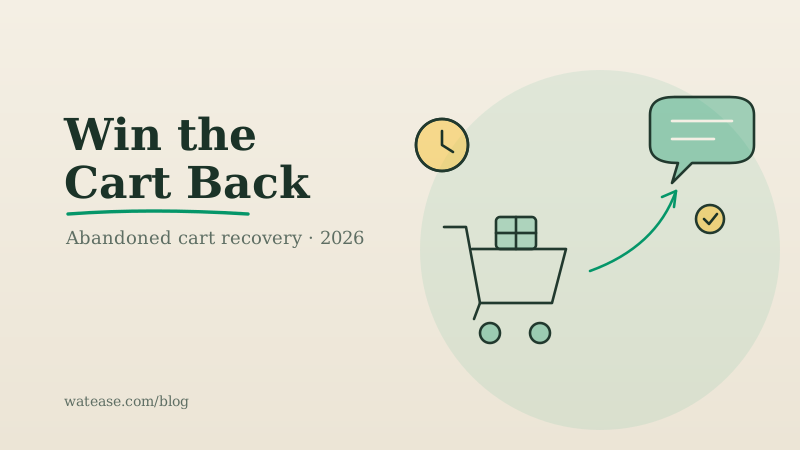
Abandoned cart recovery on WhatsApp works like this: when a buyer leaves items unpaid, an automated sequence of up to three messages — a reminder at ~45 minutes, a follow-up at ~24 hours, a final nudge at ~48–72 hours — brings a meaningful share of them back to a one-tap checkout. It outperforms recovery email for a simple reason: WhatsApp messages actually get seen. But it sits inside real constraints — opt-in consent, Meta-approved marketing templates, and frequency limits — and ignoring them costs you the channel. Here's the full setup.
Key takeaways
- Cart recovery messages are marketing-category templates in practice: pre-approval required, ~₹0.8631 per message in India as of September 2026 (Meta revises rates), and only to opted-in customers.
- The proven shape is a 3-message sequence (45 min / 24 h / 48–72 h) — more messages mostly buys blocks, not orders.
- Don't lead with a discount. Message 1 is a helpful reminder; the incentive, if any, belongs in the last message.
- Meta's per-user marketing limits and your quality rating silently cap aggressive senders — frequency discipline is a feature, not a compliance tax.
- Measure with a holdout group, or you'll credit WhatsApp for carts that would have converted anyway.
Why WhatsApp beats email for cart recovery
Recovery email's weakness isn't the copy — it's the inbox. Promotions tabs and overflowing inboxes mean most recovery emails are never opened. WhatsApp is the opposite environment: it's where Indian customers already talk to family, and a message from a brand they opted into sits in the same list. Add one-tap continuation — the message deep-links back to a checkout where UPI payment completes in seconds — and the friction that caused the abandonment is often gone on the second attempt.
The flip side: precisely because WhatsApp is personal, tolerance for spam is near zero. One careless sequence design and customers tap Block, which feeds directly into your quality rating.
Why Indian carts get abandoned (design for the real causes)
Before writing copy, know what you're recovering from. In Indian D2C, the recurring abandonment causes are:
- Payment friction — a failed UPI collect request, an OTP that never arrived, a gateway timeout. The buyer wanted to pay and couldn't; a one-tap retry link recovers these almost for free.
- Delivery-fee shock — the ₹99 shipping line that appears at the last step. If this is your pattern, message 2 should address delivery cost directly (or your pricing should).
- COD anxiety in reverse — prepaid-only checkouts lose buyers who wanted cash on delivery; if you offer COD, say so in the recovery message.
- Comparison shopping — the buyer is checking one more store. Social proof and an honest deadline are the right levers here.
- Simple distraction — dinner, a call, a dead battery. The largest bucket, and the reason a plain message 1 with no discount recovers so much.
Match your sequence to your actual leak: pull twenty abandoned carts from last month and tag the likely cause before finalising the copy below.
Run your business on WhatsApp with WatEase
Set up in minutes with guided onboarding. 0% markup on WhatsApp messages.
Get started →Want a plan sized to you? Get a quote
Prerequisites: what you need before the first reminder
- Cart events. Your store must emit "cart created / checkout started / payment completed" events. On a platform with native WhatsApp commerce, in-chat carts already do; on a website, your storefront or ecommerce platform webhooks provide them.
- Opt-in at or before checkout. A checkbox like "Send my order updates and offers on WhatsApp" — recorded with source and timestamp, per DPDPA.
- Approved templates. Submit the sequence below as marketing templates with variables; approval usually takes minutes to a couple of days.
- An automation that stops on purchase. The cardinal sin of cart recovery is messaging someone who already paid. Your automation must check order status before every send and cancel the rest of the sequence the moment payment lands.
The 3-message recovery sequence
Message 1 — the helpful reminder (30–60 minutes)
Most abandonments are accidents: a dropped connection, a failed OTP, dinner. Catch these with zero salesmanship.
"Hi {{1}}, you left {{2}} in your cart at {{3}}. We've saved it for you — complete your order in one tap: {{4}}. Need help or have a question? Just reply here."
Notes: name the actual product (it's the hook), offer help (a real reason carts die is an unanswered question), no discount.
Message 2 — answer the objection (about 24 hours)
If message 1 didn't convert, something is blocking: price doubt, trust, sizing, delivery time. Pick the objection your buyers actually have and answer it.
"Hi {{1}}, still thinking about {{2}}? A quick note — we offer {{3}} [e.g. 7-day easy returns / free delivery above ₹499 / COD] and it's rated {{4}}★ by {{5}} buyers. Your cart is saved: {{6}}"
One objection per message. Social proof (ratings, review count) does more work here than adjectives.
Message 3 — honest urgency or a small incentive (48–72 hours)
The closer. Two valid variants — pick one, never both:
Scarcity (only if true): "Hi {{1}}, heads up — {{2}} is almost sold out and we can only hold your cart till {{3}}. Complete your order: {{4}}"
Incentive: "Hi {{1}}, your cart's about to expire — here's free shipping (worth ₹{{2}}) if you complete your order by {{3}}: {{4}}"
After message 3, stop. A non-converting cart at 72 hours is a segmentation signal for next month's campaign, not a target for message 4.
Meta policy and frequency limits you must respect
- Category honesty. A purchase nudge is marketing, not utility. Meta's review recategorises or rejects miscategorised templates, and repeated gaming hurts the account. Budget at the marketing rate (~₹0.8631 in India as of September 2026) — model volumes in the conversation cost calculator.
- Per-user marketing limits. Meta limits how many marketing messages a user receives across all businesses and suppresses sends to users who ignore them — details in the glossary entry. Practically: your third message may simply not deliver to low-engagement users. Design for it.
- Quality rating. Blocks and reports from over-messaging downgrade your rating, which cuts your messaging limits. Cart sequences are the #1 place D2C brands burn their rating.
- Opt-out handling. STOP must work instantly and globally, not per campaign.
Measurement: recovery rate without self-deception
Define it tightly: recovered cart = same customer completes an order containing the abandoned items within 72 hours of a recovery message.
- Recovery rate = recovered carts ÷ carts that entered the sequence.
- Recovered revenue = value of those orders (report it net of any incentive given).
- Incrementality: keep a 10–20% random holdout that receives no messages. Your true lift is sequence recovery rate minus holdout recovery rate — some carts always come back on their own, and crediting those to WhatsApp flatters the channel. Feed conversion events back via the Conversions API if the cart came from a click-to-WhatsApp ad, so ad optimisation sees real purchases.
Per-message metrics (delivered, read, clicked) live in your platform's broadcast analytics; on WatEase each sequence step reports them separately, which tells you where the sequence leaks.
Segment before you send: not all carts are equal
A flat sequence for every cart leaves money on the table. Three splits worth making from day one:
- Cart value. A ₹4,000 cart can justify a personal follow-up from a human agent at step 2; a ₹300 cart should stay fully automated. Set a value threshold that routes high-value carts to your team's shared inbox.
- First-time vs repeat buyer. Repeat customers mostly need the reminder (cause: distraction); first-timers need trust signals (cause: doubt). Use different message-2 templates for each.
- Payment-failed vs browsed-away. A failed payment is a hot lead — send the retry link within minutes, not at 45; a browsed-away cart follows the standard clock.
Setting it up on WatEase (or any capable platform)
The generic recipe: cart-event trigger → wait 45 minutes → check order status → send template 1 → wait 24 h → check → template 2 → wait 24–48 h → check → template 3 → exit. On WatEase this is a visual workflow on the automation builder with the templates from the template library, in-chat UPI checkout links per cart, and automatic sequence cancellation on payment. Whatever platform you use, verify the three non-negotiables: stop-on-purchase, instant opt-out, and per-step analytics.
Cart recovery is the highest-leverage automation most Indian D2C brands haven't set up: the audience is warm (they chose the product), the cost is a few rupees per cart, and the build takes an afternoon. Build the three messages, respect the limits, measure against a holdout — and let the sequence quietly pay rent every day.