India's automobile industry is one of the largest in the world, with over 25 million vehicles sold annually across cars, two-wheelers, and commercial vehicles (Source: SIAM Annual Report, 2024). Yet most dealerships and spare parts sellers still rely on phone calls, walk-ins, and outdated CRM systems to manage customer relationships. WhatsApp is changing this rapidly.
With Meta reporting more than 500 million WhatsApp users in India (Meta, 2023), auto businesses that adopt WhatsApp commerce are seeing faster lead conversions, higher service retention, and streamlined spare parts ordering. From Maruti dealerships in Delhi to Royal Enfield accessory shops in Coimbatore, the shift is well underway.
Why Is WhatsApp the Right Channel for Indian Auto Businesses?
The automobile purchase journey in India is uniquely personal. Buyers research online but want human interaction before making a decision. WhatsApp bridges this gap perfectly by offering the convenience of digital communication with the personal touch of one-on-one conversation.
Consider the typical car-buying journey. A customer sees an ad on Instagram, clicks a WhatsApp link, and instantly connects with a sales executive. Within minutes, they receive a vehicle catalog with specs, on-road pricing for their city, and available colour options. No app downloads, no form submissions, no waiting for a callback.
Key reasons WhatsApp works for auto businesses:
- High-value purchases need trust: Customers feel more comfortable discussing ₹5-50 lakh purchases on a familiar platform
- Visual-first communication: Photos and videos of vehicles, interiors, and spare parts are easily shared
- Regional language support: A dealer in Tamil Nadu can communicate in Tamil while another in Gujarat uses Gujarati
- Family decision-making: WhatsApp groups allow families to discuss vehicle options together with the dealer
Platforms like WatEase enable auto dealers to manage hundreds of such conversations simultaneously without losing the personal touch.
How Are Dealerships Using WhatsApp for Vehicle Sales?
Progressive dealerships across India have built complete sales funnels on WhatsApp. The process typically follows a structured flow that moves customers from inquiry to delivery.
Lead capture and qualification begins when a prospect messages the dealership. An automated chatbot asks about their preferred vehicle segment, budget range, and whether they want a new or pre-owned vehicle. This information is instantly logged in the CRM system and assigned to the right sales executive.
Vehicle catalog sharing is where WhatsApp truly shines. Dealers create rich catalogs with high-resolution images, 360-degree interior views, variant comparisons, and on-road price breakdowns. Customers can browse these catalogs within WhatsApp without visiting any external website.
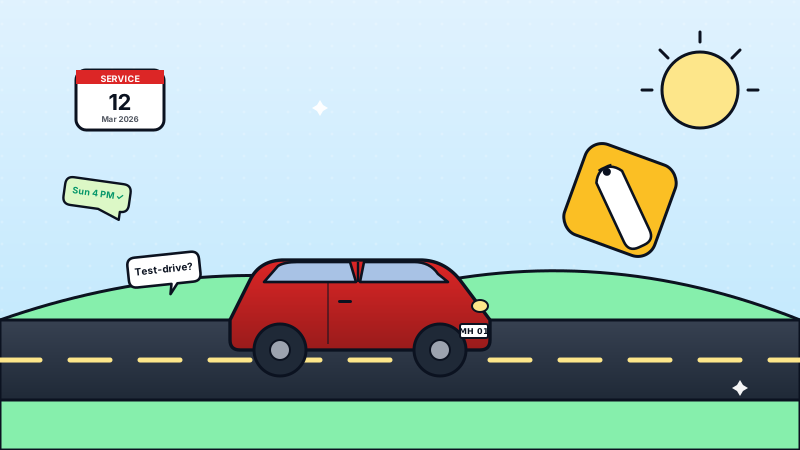
Test drive booking happens seamlessly through WhatsApp. Customers select a preferred date, time, and location — many dealerships now offer doorstep test drives — and receive instant confirmation with the sales executive's details. Automated reminders are sent 24 hours and 1 hour before the scheduled test drive.
Price negotiation and booking is handled through secure WhatsApp conversations. Dealers share detailed quotations as PDF documents, customers can discuss exchange bonuses for their old vehicle, and booking amounts are collected via integrated UPI payment links.
How Do Spare Parts Sellers Manage Orders Through WhatsApp?
The aftermarket spare parts industry in India is one of the country's largest auto segments, running into tens of thousands of crores annually. Most of this business still runs on phone calls and physical visits to auto parts markets like Kashmere Gate in Delhi or Peenya in Bangalore.
WhatsApp is transforming this space by enabling parts sellers to create searchable digital catalogs. A mechanic in Lucknow can now message a parts dealer, specify the vehicle make and model, and receive a list of available parts with prices within seconds.
Automated part lookup uses chatbot flows where customers select their vehicle brand, model, and year. The system then displays compatible parts with OEM and aftermarket options, pricing, and availability status. This eliminates the back-and-forth phone calls that can drag on for many minutes per inquiry.
Bulk ordering for workshops is simplified through WhatsApp. Mechanics and workshop owners send their requirements as a list, and the system generates a consolidated quotation with volume discounts. Repeat orders are even easier — customers simply forward their previous order message and confirm.
Delivery tracking keeps customers informed throughout the shipping process. From order confirmation to dispatch, transit updates, and delivery confirmation — every step is communicated through WhatsApp notifications.
Run your business on WhatsApp with WatEase
Set up in minutes with guided onboarding. 0% markup on WhatsApp messages.
Get started →Want a plan sized to you? Get a quote
What Role Do Service Reminders Play in Customer Retention?
Vehicle service is where long-term revenue lies for auto businesses. A single car can generate service revenue for many years after purchase. Yet most dealerships lose customers after the warranty period because they fail to maintain engagement.
WhatsApp-based service reminders solve this problem. Using platforms like WatEase, service centres can set up automated reminders based on:
- Kilometre-based service: Reminders at 5,000 km, 10,000 km, and subsequent intervals
- Time-based service: Quarterly or half-yearly reminders for customers who drive less
- Seasonal alerts: Pre-monsoon checkups, AC servicing before summer, battery checks before winter
- Insurance and PUC renewal: Timely reminders with renewal assistance
These automated touchpoints keep the dealership top-of-mind. When a customer receives a friendly WhatsApp message saying "Your Creta is due for its 20,000 km service. Book a slot now and get 15% off on labour charges," the conversion rate is remarkably high.
How Can Auto Businesses Build a Complete WhatsApp Commerce Strategy?
Building an effective WhatsApp commerce strategy for an automobile business requires a systematic approach. Here is a roadmap that works across dealerships, service centres, and parts sellers.
Step 1: Set up a verified WhatsApp Business account with your business name, address, and category. This builds immediate trust with customers who see the green verified badge.
Step 2: Create structured catalogs for your products and services. For dealerships, this means vehicle variants with pricing. For parts sellers, this means categorized parts lists. For service centres, this means service packages with transparent pricing.
Step 3: Build automated flows for common queries. Most auto businesses receive the same 10-15 questions repeatedly — on-road price, EMI options, exchange value, service cost, part availability. Automating these through WhatsApp chatbots frees up your team to handle complex negotiations.
Step 4: Integrate with your existing systems. Connect WhatsApp with your DMS (Dealer Management System), inventory management, and accounting software. This ensures that every WhatsApp conversation is tracked and every order flows into your operational systems.
Step 5: Train your team on WhatsApp selling techniques. The tone on WhatsApp is different from phone calls or showroom conversations. Messages should be concise, visually rich, and action-oriented.
What Results Are Indian Auto Businesses Seeing with WhatsApp?
Early adopters in the Indian automobile industry are reporting significant improvements across key metrics. Dealerships using WhatsApp as a primary sales channel typically report much faster lead response times, which tends to correlate with higher conversion rates.
Service centres using automated WhatsApp reminders often see noticeably higher service retention beyond the warranty period. Spare parts sellers report a sizeable reduction in order processing time because customers can self-serve through catalog bots instead of calling repeatedly.
The cost savings are equally impressive. A mid-sized dealership handling 500 inquiries per month through WhatsApp saves approximately ₹1.5-2 lakh monthly on call centre costs alone (WatEase dealership cohort, 2025). When combined with higher conversion rates and better customer retention, the ROI is substantial.
The directional ranges below reflect WatEase merchant data (internal benchmark, methodology on request, as of June 2026) and are indicative rather than guaranteed outcomes:
| Metric | Traditional (phone + walk-in) | WhatsApp Business API |
|---|---|---|
| Average lead response time | 4–8 hours | Under 90 seconds |
| Cost per qualified lead | ₹120–₹250 | ₹25–₹60 |
| Test-drive no-show rate | ~40% | Under 15% (with confirm + 24h + 1h reminders) |
| Service-recall acceptance | 18–25% | 35–45% |
| Spare-parts order processing time | 15–20 min per call | Under 2 min (catalog self-serve) |
For the underlying API capabilities, see the official WhatsApp Business Platform documentation. Pair this with a structured SEO playbook for Indian D2C brands if you also run a brand website or used-car portal — the two discovery channels reinforce each other.
What Does the Future Hold for WhatsApp in the Auto Industry?
The automobile industry in India is rapidly embracing digital transformation, and WhatsApp is at the centre of this shift. As electric vehicles grow in popularity, WhatsApp will play a crucial role in educating customers about new technology, managing charging station bookings, and providing battery health updates.
For auto businesses ready to embrace this change, the time to start is now. The early movers are already building loyal customer bases on WhatsApp, and catching up will only get harder.
Ready to transform your automobile business with WhatsApp? Tell us your use case and we quote a plan that fits, or get started today.