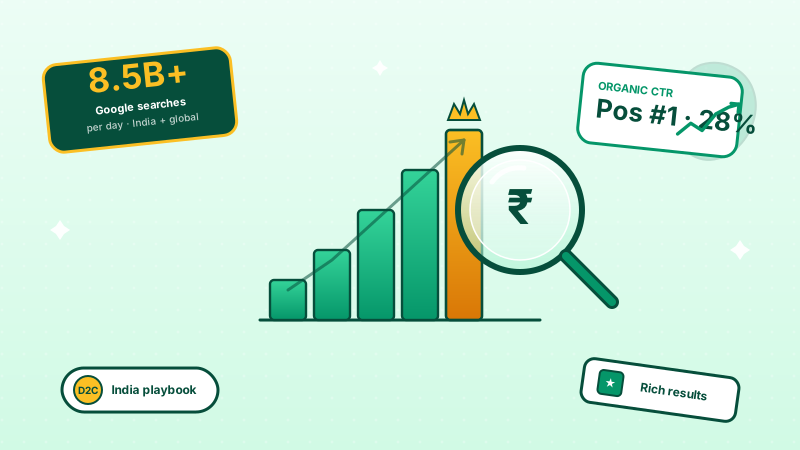
SEO for Indian D2C brands in 2026 is the practice of earning organic search visibility on Google, Bing, and AI-powered answer engines for the queries your category buyers actually type. It is the highest-leverage growth channel a direct-to-consumer brand can build because every backlink, every ranking, and every conversion compounds on a domain you own — unlike Meta or Amazon, where the platform owns the audience and the rules change every quarter.
This playbook is written for founders and growth leads at Indian D2C brands between ₹50 lakh and ₹50 crore ARR. It walks through what to do, in what order, with what budget, and what to skip. By the end you will have a 90-day SEO roadmap you can hand to one writer and one developer and start shipping on Monday.
What Is D2C SEO and Why Does It Matter in 2026?
D2C SEO is search engine optimisation for direct-to-consumer brand websites — not marketplaces, not aggregators. It targets three intent layers: informational ("what is ashwagandha"), commercial ("best ashwagandha brand India"), and transactional ("buy ashwagandha tablets online"). In 2026 it matters more than ever because paid-media costs in India have continued to climb while UPI-enabled checkout has made first-purchase conversion meaningfully easier from any traffic source — organic included.
The compounding economics are the real story. As an illustrative example, suppose a single category guide ranks on page one of Google for a 5,000-search-per-month keyword and a typical page-one position sends, say, around 1,000 visitors per month at zero variable cost. Compare that to a click-to-WhatsApp ad at ₹14 CPC — the same 1,000 visitors would cost ₹14,000 per month, every month, forever. (Actual click-through rates and CPCs vary by query, position, and category.)
How Is SEO Different for Indian D2C Brands vs. Global Brands?
Indian D2C SEO differs from global SEO in four practical ways: language and code-switching ("besan protein powder" outranks "chickpea protein"), pricing-currency in titles (in WatEase merchant data, ₹ symbols in titles have been associated with higher CTR on some commercial queries — internal benchmark, methodology on request, as of June 2026), regional intent ("D2C brand in Mumbai" matters where it wouldn't in the US), and a much heavier weighting toward mobile-first design because 78% of Indian e-commerce traffic comes from mobile, per IAMAI 2025.
You also compete with a different stack of incumbents. Where US D2C brands fight Amazon, REI, and category-specific marketplaces, Indian D2C brands fight Amazon India, Flipkart, Nykaa, Myntra, BigBasket, and 1mg — all of which dominate transactional queries with massive domain authority. The winning strategy is rarely head-on. Instead, win on informational and long-tail commercial queries where marketplaces have weak content depth.
Which Keywords Should an Indian D2C Brand Target First?
Start with three buckets: brand-defense keywords ("[your brand] reviews"), category-education keywords ("how to choose a serum for oily skin"), and bottom-of-funnel comparison keywords ("[your brand] vs [competitor]"). Avoid generic head terms ("skincare India") for the first 12 months — domain authority is too low to compete. Long-tail informational queries with 200–2,000 monthly searches and KD under 30 are the fastest path to first traffic.
Use Google Search Console for query discovery once you have any traffic. For pre-launch research, the cheapest stack is Google's "People Also Ask" boxes plus a free tier of Ubersuggest or Keywords Everywhere (the ₹820/month plan covers most early-stage needs). Compile every keyword into a master sheet with columns for intent, search volume, KD, current rank, target URL, and content status. This sheet becomes your editorial calendar.
Pair this approach with strong WhatsApp commerce funnels so the organic traffic you earn actually converts — paid acquisition and organic acquisition share a checkout, and improving one lifts the other.
Run your business on WhatsApp with WatEase
Set up in minutes with guided onboarding. 0% markup on WhatsApp messages.
Get started →Want a plan sized to you? Get a quote
What On-Page SEO Elements Move the Needle for D2C Stores?
The on-page elements that actually move D2C rankings in 2026 are: a keyword-led title tag under 60 characters, a benefit-led meta description under 160 characters, one H1 that matches search intent, H2 subheadings phrased as the questions buyers ask, alt text on every product image, internal links from three to five related pages, and clean URL slugs without dates or session IDs. Together these tend to account for a substantial share of the on-page ranking differences we observe across D2C sites (directional, based on our own hands-on experience rather than a formal study).
The single biggest mistake we see is generic product titles ("Premium Vitamin C Serum"). Replace with intent-matched titles ("Vitamin C Serum for Oily Skin — 20% L-Ascorbic Acid | [Brand]"). Indian buyers search descriptively. Match that language. The same applies to category pages — /collections/best-sellers should become /collections/best-selling-skincare-india.
What Technical SEO Do D2C Sites Actually Need?
Technical SEO for a D2C site comes down to five non-negotiables: Largest Contentful Paint under 2.5 seconds on 4G, INP under 200ms, CLS under 0.1, mobile-first responsive design, and a crawlable sitemap. If those five are green in Google's Core Web Vitals report, you have already outperformed a large share of competing Indian D2C sites. Everything beyond is optimisation, not foundation.
Page speed is where most Shopify and WooCommerce stores quietly bleed rankings. Audit using PageSpeed Insights on a real Indian 4G connection (Bengaluru and Patna both — the variance matters). Convert hero images to WebP or AVIF, lazy-load below-the-fold images, defer non-critical JavaScript, and pre-load the fonts you actually use. Many D2C sites can meaningfully lift their mobile LCP in a single afternoon by deleting unused apps and third-party scripts.
For HTTPS, HSTS, canonical tags, and robots.txt — these are setup-and-forget if your platform is modern. If you are still on a custom PHP build from 2019, that is the bigger problem; replatforming is cheaper than fighting it for another year.
Which Schema Markup Types Drive Rich Results for D2C?
Six schema types deliver the highest rich-result yield for D2C stores. Implement them in this order: Product (price + availability stars in SERPs), Review and AggregateRating (the ★★★★★ widget), FAQPage (expandable Q&A under your listing), BreadcrumbList (navigation trail in SERPs), Article (author + date for blog posts), and Organization (knowledge panel anchor).
| Schema type | Rich result in SERPs | Best applied on | Typical CTR impact (directional) |
|---|---|---|---|
Product |
Price, availability, currency | Product detail pages | Can lift CTR |
Review / AggregateRating |
Yellow star widget | Product pages with ≥10 reviews | Often a strong CTR lift |
FAQPage |
Expandable Q&A accordion | Blog posts, landing pages | Can lift CTR |
BreadcrumbList |
Breadcrumb trail | Every indexed page | Modest CTR effect |
Article |
Author, date, hero image | Blog posts | Modest CTR effect |
Organization |
Knowledge panel (right rail) | Homepage | Brand defense |
Implementation is JSON-LD in the <head>. Validate every page through Google's Rich Results Test before shipping. A single malformed schema block can suppress the entire rich result.
How Do You Build Backlinks for an Indian D2C Brand?
Backlinks remain the highest-weighted Google ranking signal, but the path for an Indian D2C brand is different from global SaaS link building. The four tactics that actually work in 2026 are: founder-led HARO and Qwoted responses (1–2 hours per week can yield a steady trickle of high-DA links over time), digital PR around your category data (a strong annual original research report can land a meaningful number of links), guest posts on category-relevant Indian publications (YourStory, Inc42, ET Retail), and supplier or stockist mentions (your retail partners, manufacturers, certifying bodies often link back if you ask).
Avoid paid link directories, PBNs, and "guaranteed do-follow" Indian SEO services — Google's spam team has improved aggressively in recent years and many of these vendors deliver links that tend to be devalued before long. The trust you build with one genuine Inc42 feature typically outweighs a long list of directory listings.
How Should D2C Brands Structure Content for Topical Authority?
Topical authority is built through the pillar-and-cluster model: one comprehensive pillar page covers a broad category at depth, surrounded by 6–12 cluster posts that drill into specific sub-topics, each linking back to the pillar. For a skincare D2C, the pillar might be "Skincare for Indian Skin Types" with clusters on "vitamin C for dusky skin", "salicylic acid for monsoon humidity", "ceramides for AC-dry skin", and so on.
The reason this works is Google now scores topic depth as much as individual page quality. Three deep posts on related sub-topics beat ten shallow posts on disconnected ones. Build one cluster fully before starting the next — half-built clusters look thin to crawlers and hurt the pillar's authority.
This is exactly the architecture we recommend pairing with WhatsApp marketing campaigns — the organic content captures intent, WhatsApp closes the loop with personalised follow-up.
What KPIs and Tools Should You Track?
Track six SEO KPIs: organic sessions (Google Analytics 4), keyword rankings for your top 50 targets (Ahrefs or Semrush), organic conversion rate by landing page (GA4), backlink count and referring domains (Ahrefs free tier or Ubersuggest), Core Web Vitals scores (Search Console), and indexed-page count vs submitted-page count (Search Console). Anything beyond these six is a vanity metric or a tool's attempt to upsell.
| Tool | What it does best | Indian D2C use case | Approximate monthly cost |
|---|---|---|---|
| Google Search Console | Indexing, CTR, query data | Foundation — every site needs it | Free |
| Google Analytics 4 | Traffic and conversion tracking | Organic conversion attribution | Free |
| Ahrefs Lite | Rank tracking, backlinks, content gap | Primary SEO platform | ~₹10,000 |
| Ubersuggest | Cheap keyword research | Starter-stage replacement for Ahrefs | ~₹2,500 |
| Screaming Frog (free tier) | Technical site crawl | Pre-launch audit, monthly hygiene | Free up to 500 URLs |
| PageSpeed Insights | Core Web Vitals on real connections | Speed regression monitoring | Free |
| Schema Markup Validator | Validates JSON-LD | Before every schema deploy | Free |
| Surfer SEO or Frase | Content brief generator | Optional — speeds up writing | ~₹5,000 |
Pair organic traffic data with Instagram analytics for a unified picture of paid and earned discovery. The two channels reinforce each other when measured side-by-side.
What Is the 90-Day SEO Roadmap for a New D2C Store?
The 90-day roadmap below is the exact sequence we hand to early-stage D2C founders. It assumes one person spends 10 hours a week and one writer ships 8 articles a month. Total monthly cost: ₹25,000–₹60,000 depending on how much you outsource.
Days 1–14 — Foundation. Set up Google Search Console, GA4, and Bing Webmaster Tools. Audit current site with Screaming Frog and PageSpeed Insights. Fix Core Web Vitals failures. Submit XML sitemap. Verify mobile-friendly status. Install Organization + LocalBusiness + Website JSON-LD on the homepage.
Days 15–30 — Keyword research and architecture. Build a 200-keyword master sheet across the three intent buckets. Cluster into 3–5 pillar topics. Audit URL structure and consolidate or 301 thin pages. Write title tags and meta descriptions for every category and product page. Implement Product + Review + FAQPage schema on at least the top 20 products.
Days 31–60 — Content sprint #1. Publish your first pillar page (2,500–3,500 words) and three cluster posts (1,200–1,800 words each) supporting it. Interlink obsessively. Start founder-led HARO responses. Reach out to 10 Indian publications for one initial guest feature. Track first-rank movements weekly in Search Console.
Days 61–90 — Content sprint #2 and link building. Ship a second pillar plus four more clusters. Refresh your first pillar with whatever new questions Search Console shows you. Land at least 5 referring domains via guest posts, HARO, or supplier mentions. Run a Lighthouse audit and re-fix any Core Web Vitals regressions. Begin tracking conversion rate by landing page so you know which content drives revenue, not just sessions.
By day 90, with consistent execution, you can realistically expect your first non-brand long-tail keywords to start appearing on the first couple of pages — though timelines vary by niche and competition. By day 180, with the same cadence, the strongest cluster posts often climb toward the top of page one and start driving meaningful traffic. This is the boring truth of SEO: a large share of brands give up in the early months, exactly when the curve is about to bend.
Where Should You Go Next After This SEO Playbook?
SEO is no longer a standalone discipline in 2026. The same content that earns Google rankings also gets cited in Google AI Overviews, ChatGPT, and Perplexity — but only if you structure it correctly. To extend this playbook into AI-era search, read our companion guides on Answer Engine Optimization (AEO) and Generative Engine Optimization (GEO). They cover the schema, content formats, and bot-access settings that turn an SEO-optimised page into one that wins citations in the AI answers your buyers will increasingly see first.
If you sell on WhatsApp alongside your website — most Indian D2C brands now do — the WatEase commerce platform and feature suite are built to make organic and conversational traffic share the same catalog, cart, and CRM. The cleaner that handoff, the higher the conversion rate on every organic visitor you earn.