Answer Engine Optimization (AEO) is the practice of structuring web content so that search engines and AI systems can extract direct answers from it — and serve those answers inside Google AI Overviews, Featured Snippets, People Also Ask boxes, voice search results, and AI chatbot citations. It is what happens to SEO when the "ten blue links" are no longer the main attraction.
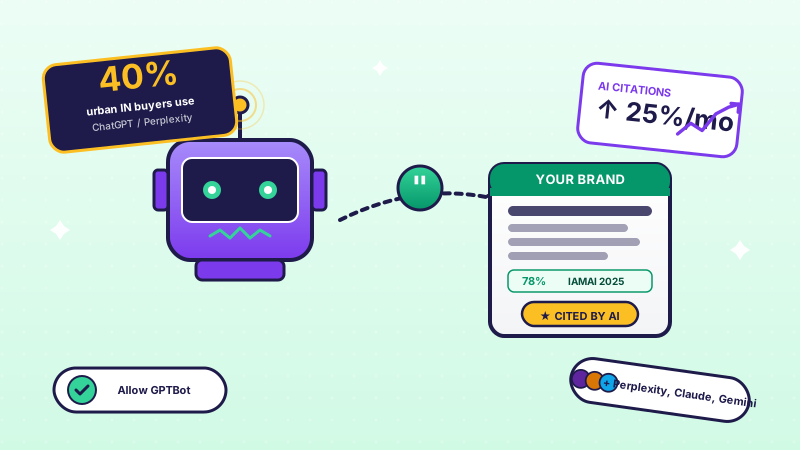
For Indian D2C founders, AEO matters now because Google's AI Mode and AI Overviews have rolled out to Indian users through 2025 and 2026 (Google Search Liaison announcements, 2024–2025), voice queries through Google Assistant and Alexa now drive a meaningful and growing share of mobile search sessions, and a large and rising share of urban Indian buyers consult ChatGPT or a similar AI assistant before a non-trivial purchase. The brands that show up inside those answer surfaces — not just on page two of Google — win the next decade of organic discovery.
What Is Answer Engine Optimization (AEO)?
Answer Engine Optimization is the discipline of formatting content so that machines — not just humans — can lift a complete, accurate answer from it and present that answer at the top of a search experience. It uses structured data (JSON-LD), question-shaped headings, direct-answer paragraphs of 40–60 words, and clean entity references. It is the bridge between classic SEO (rank for a query) and generative search (be cited as the source of an answer).
AEO has technical and editorial components. Technically, it relies on schema types — FAQPage, HowTo, QAPage, SpeakableSpecification — that signal "this content is a direct answer." Editorially, it relies on writing where the very first sentence under each H2 answers the heading completely, in plain language, in under 60 words.
How Is AEO Different From SEO?
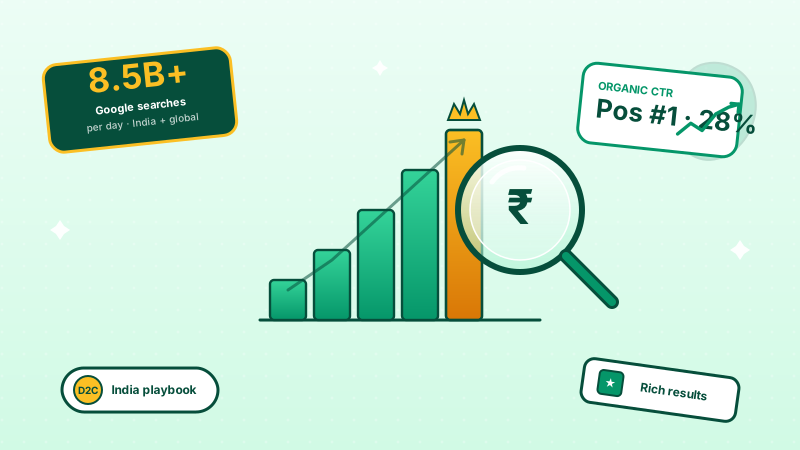
AEO and SEO share infrastructure but target different surfaces and intents. SEO optimises for the ranked list of links Google has shown for 25 years; AEO optimises for the answer Google extracts and shows above that list. The same page can win both — but only if it is structured for both.
| Dimension | SEO | AEO |
|---|---|---|
| Primary surface | Top 10 organic links | AI Overview, Position 0, PAA, voice |
| KPI | Rank position, organic sessions | Snippet ownership, citation count, PAA capture |
| Content unit | Page | Question + 40–60 word answer block |
| Required schema | Article, Breadcrumb | FAQPage, HowTo, QAPage, Speakable |
| User journey | Click-through | Answer-then-maybe-click |
| Failure mode | Rank #11 (page 2) | Rank #1 but no snippet shown |
| Brand benefit | Traffic | Authority + traffic |
The strategic implication is simple: never optimise for one without the other. A page built for snippets that doesn't rank top 10 wins nothing. A page built for SEO without structured answers cedes the snippet to a competitor who has both. Pair this guide with our SEO playbook for Indian D2C brands and build for both at once.
Why Does AEO Matter for Indian D2C Brands Right Now?
AEO matters more in India than in most markets because Indian users are voice-first, mobile-first, and increasingly AI-first. Voice queries make up a sizeable share of mobile search; Google AI Overviews increasingly appear on commercial queries served to Indian users; and Hindi-English code-switched queries — "best protein powder kaunsa hai" — get answered inline more often than purely English queries because Google's AI is better at synthesising than ranking for low-volume bilingual terms.
The competitive opportunity is also asymmetric. Most Indian D2C brands have not yet adapted content for AEO. They still write 1,800-word blog posts with hero opinions, "in this article we will explore" intros, and no FAQ schema. A brand that simply ships AEO-formatted content for six months can leapfrog category incumbents on every answer surface — because the incumbents are still writing for 2019 Google.
Run your business on WhatsApp with WatEase
Set up in minutes with guided onboarding. 0% markup on WhatsApp messages.
Get started →Want a plan sized to you? Get a quote
How Do Google AI Overviews Pick the Sources They Cite?
Google AI Overviews select sources using a hybrid of three signals: traditional ranking (your page should already be in the top 5 organic results for the query or a closely related one), content-structure signals (clear H2 questions with direct, fact-dense answers immediately beneath), and entity-trust signals (the page's domain has Organization schema, author bylines, and consistent NAP data tied to a real business).
The kill condition is contradiction. If two sources Google trusts give different answers for the same query, neither tends to be cited — Google picks a third, often more neutral source. The implication for D2C brands is to be specific and verifiable: cite real, named, dated data (for example, "X% of Indian e-commerce traffic is mobile, per [a named industry report with its year]") rather than vague claims ("most users prefer mobile"). Always attribute the figure to a source you can link to, and present it as directional if you can't. Specificity is the cheapest moat in AEO.
What Is the 40–60 Word Direct Answer Format and Why Does It Work?
The 40–60 word direct answer is a paragraph that opens the section under an H2 question, answers the question completely in plain language, and contains no preamble. It works because Google's snippet selector specifically extracts paragraphs in this length range, and because LLMs (ChatGPT, Perplexity, Claude) tokenise these blocks cleanly when they cite sources. Shorter blocks lack context; longer blocks get truncated.
Every H2 in this article uses the format — read this paragraph, then read the one under "How Do Google AI Overviews Pick the Sources They Cite?" above. Same shape, every time. That repetition is not stylistic monotony; it is structural signal. Once you start writing this way, you will notice you can no longer hide behind throat-clearing intros — which is the point.
Which Schema Types Power AEO Results?
Five schema types do almost all of the heavy lifting for AEO. Implement them on the right page types and validate before shipping. Schema is JSON-LD inserted in the <head>; the official Google structured data guidelines cover syntax and Search Console testing tools.
| Schema type | What it unlocks | Best applied on |
|---|---|---|
FAQPage |
Expandable Q&A block beneath your result | Landing pages, blog posts, category pages |
HowTo |
Step-by-step rich result with numbered cards | Tutorials, onboarding guides |
QAPage |
Marked-up question-and-answer pages | Help center, support docs |
SpeakableSpecification |
Voice-assistant readability for selected blocks | News, key landing pages |
Article with mainEntityOfPage |
Author + date + headline shown in results | All blog content |
Two implementation pitfalls to avoid: never apply FAQPage to questions whose answers are gated behind a login, paywall, or pop-up — Google penalises this aggressively. And never duplicate the same FAQPage block across more than three URLs; pick a canonical page and use internal links from the others.
How Do You Win Featured Snippets (Position 0)?
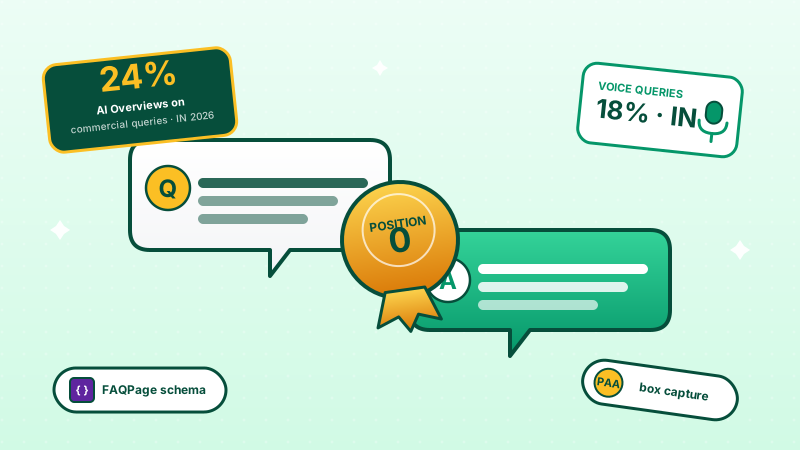
Winning a Featured Snippet (Position 0) requires three conditions in combination: already ranking in Google's top 5 organic results for the query, structuring an H2 as the literal question Google extracts (often visible in PAA boxes), and providing a 40–60 word direct answer immediately beneath that H2. For paragraph snippets, plain prose works; for list snippets, format the answer as an <ol> or <ul>; for table snippets, use an HTML <table>.
Audit existing rankings monthly in Google Search Console. Filter to queries where you rank 3–10 with the question intent. Open each ranking page, add or restructure an H2 to match the PAA phrasing for that query, and rewrite the first paragraph as a 40–60 word direct answer. Most snippet wins come from rewrites of pages that already rank — not from net-new content.
How Do You Capture People Also Ask (PAA) Boxes?
PAA boxes are won by addressing multiple related questions on a single page, each as an H2 with a tight direct answer, and supporting them with a FAQPage schema block. Google rotates PAA entries dynamically, so a single page can capture multiple PAA slots over time even if you didn't write for each specific question — because Google can extract any structured Q&A pair.
The tactic that yields the most PAA capture per hour of writing: at the end of every long-form post, add an FAQ section with 6–8 questions you sourced directly from the live PAA box for your primary keyword. Use the exact phrasing Google shows. This single move can capture several additional PAA positions per post over the following weeks, though results vary by keyword competitiveness and domain authority.
How Do You Optimize for Voice Search (Siri, Alexa, Google Assistant)?
Voice search optimization comes down to four practices: a conversational H2 question format ("How much does X cost in India?" not "X pricing India"), 25–35 word direct answers under those H2s (voice assistants prefer the shortest complete answer), SpeakableSpecification schema marking the speakable blocks, and structured local data (NAP — name, address, phone — consistent across your site and Google Business Profile) for "near me" intent.
Voice traffic skews heavily toward local, conversational, and yes/no queries. Indian D2C brands selling locally — pharmacies, jewellers, salons, kirana suppliers — earn meaningful voice traffic. Pure-play national D2C brands earn less voice traffic directly but benefit indirectly through Alexa's product recommendations, which pull from Bing and Amazon listings rather than Google. Cover all three.
What's the AEO Audit Checklist for a Live Site?
Run this 10-point AEO audit on every important page on your site. It takes about 20 minutes per page and can meaningfully lift snippet ownership across a category cluster over a quarter or two, though the size of the gain depends on your starting rankings and competition.
- Does every H2 read as a question buyers actually type? Check Google PAA for the parent keyword.
- Is the first paragraph under each H2 a complete answer in 40–60 words, with no preamble?
- Is there at least one HTML
<table>or numbered<ol>on the page (these win table and list snippets)? - Is
FAQPageschema present with 5–8 real questions, validated through Google's Rich Results Test? - Is
Articleschema present with author, datePublished, dateModified, and image fields populated? - Is
BreadcrumbListschema present and correct? - Does the page rank in Google's top 10 for the primary keyword? If not, fix SEO basics first — AEO is leverage, not magic.
- Are key facts attributed to a named, dated source (for example, "per [named report], [year]"), not vague ("studies show")?
- Is the page accessible to Bingbot and to GPTBot/ClaudeBot/PerplexityBot in
robots.txt? Blocking AI bots removes you from AEO and GEO surfaces simultaneously. - Is there a clear
Organizationschema on the homepage so Google links the page to a verified entity?
Pages that pass all ten points tend to earn answer-surface positions at a far higher rate than pages that pass only a handful. The audit is cheap. The compounding upside on a high-intent commercial keyword is enormous.
How Does AEO Connect to the Wider WatEase Stack?
AEO is one third of an AI-era search strategy. The other two are classic SEO for Indian D2C brands (which gets you ranking in the first place) and Generative Engine Optimization (GEO) (which gets you cited inside ChatGPT, Perplexity, and Claude). Build all three in parallel — the work overlaps heavily and the surfaces multiply your discoverability.
If your D2C brand also sells on WhatsApp — the dominant conversion channel for Indian buyers — the WatEase AI suite and feature stack help close the loop between an organic visitor who found you via AI Overview and a buyer who completes checkout inside a WhatsApp conversation. The cleaner that handoff, the higher the conversion rate on every snippet, citation, and PAA capture you earn. For the broader conversational-commerce context, see what is WhatsApp commerce and our India guide.