Generative Engine Optimization (GEO) is the practice of structuring web content so that large language models — ChatGPT, Perplexity, Claude, Gemini, Microsoft Copilot, and Google AI Mode — cite your brand as a source when they generate answers to buyer questions. It is the third layer of AI-era search, sitting alongside SEO (which earns rankings) and AEO (which earns answer-box extractions inside search engines).
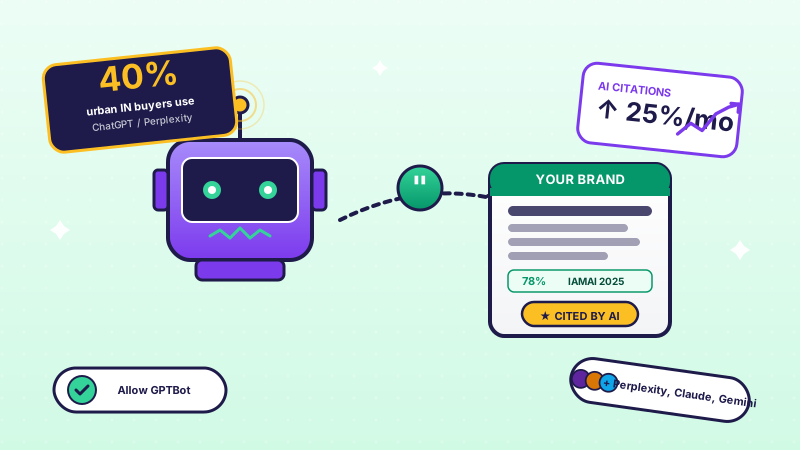
For Indian D2C brands, GEO matters because a growing share of urban Indian buyers now consult ChatGPT or Perplexity before non-trivial purchases, and that share appears to be rising quarter on quarter (directional; based on WatEase observation of Indian D2C buyer behaviour, as of June 2026). The brands that get cited inside those AI answers shape the consideration set before a single Google search happens. This guide explains how generative engines pick sources, the seven signals that matter most, and a per-engine checklist for landing in their cited results.
What Is Generative Engine Optimization (GEO)?
Generative Engine Optimization is the discipline of writing, structuring, and publishing content in formats that large language models can ingest, extract, attribute, and cite. It uses many of the same building blocks as SEO and AEO — clean HTML, structured data, factual specificity, clear entity references — but optimises for a different output: a sentence-level citation embedded in a multi-source generated answer, not a blue-link ranking.
The mechanics are different too. Where Google's classic ranker decides which links to show, LLMs decide on a smaller handful of sources to read, summarise, and credit by name. The unit of optimisation shifts from "page" to "fact." A page can be cited for a single statistic it contains, even if most of its content is irrelevant to the query.
How Is GEO Different From SEO and AEO?
GEO, SEO, and AEO are three concentric circles of search optimisation in 2026, sharing core tactics but targeting different surfaces, engines, and ranking mechanics. The clearest way to see the difference is side-by-side.
| Dimension | SEO | AEO | GEO |
|---|---|---|---|
| Target surface | Google/Bing organic links | AI Overview, Featured Snippet, PAA, voice | ChatGPT, Perplexity, Claude, Gemini answers |
| Engines | Google, Bing, Yandex | Google Search, Google Assistant, Alexa, Siri | LLM chatbots + LLM-powered search |
| Unit of optimisation | Page | Question + 40–60 word answer | Fact + citation context |
| KPI | Rank position, organic sessions | Snippet/PAA ownership | Citation count per query, referral traffic |
| Critical schema | Article, Breadcrumb | FAQPage, HowTo, Speakable | Same as AEO + factual content + bot access |
| Distinct signal | Backlinks | Direct-answer formatting | Citable specifics + entity authority |
| Bot access required | Googlebot, Bingbot | Same + AssistantBot | Same + GPTBot, ClaudeBot, PerplexityBot, GoogleOther |
The strategic upshot: optimising for one engine increasingly optimises for all three, but only if you allow every relevant crawler and structure content for both human and machine extraction. Pair this guide with our SEO playbook and AEO guide — the three together cover every meaningful discovery surface a 2026 D2C brand can win.
Which Engines Does GEO Target in 2026?
GEO targets seven distinct generative surfaces, each with its own crawler, indexing cadence, and source-selection logic. Optimise primarily for the four that move the needle for Indian D2C: Perplexity, ChatGPT, Google AI Mode, and Bing/Copilot. The others reach smaller audiences but compound your authority signals across the ecosystem.
- Perplexity — cites several sources per answer, refreshes its index frequently, weights recency and statistical specificity heavily. Highest-leverage engine for new content.
- ChatGPT (with browsing) — uses Bing's index for live retrieval; cites a small handful of sources per answer; weights authority and entity recognition.
- Google AI Mode / AI Overviews — pulls from Google's main index; weights traditional SEO + AEO signals; lowest delta vs classic SEO.
- Claude — uses a web search index; cites a few sources per answer; weights factual neutrality and structured prose.
- Gemini — pulls from Google's index plus YouTube; benefits from video schema and YouTube channel authority.
- Microsoft Copilot — Bing-powered, similar surface area to ChatGPT browsing.
- You.com, Andi, others — smaller share, generally inherit signals from upstream indexes.
Run your business on WhatsApp with WatEase
Set up in minutes with guided onboarding. 0% markup on WhatsApp messages.
Get started →Want a plan sized to you? Get a quote
How Do LLMs Actually Pick Sources to Cite?
LLMs pick sources by combining a retrieval step (a classic search index returns a set of candidate URLs for the query) and a synthesis step (the LLM reads top candidates, evaluates which contain extractable, specific, attributable facts, and weaves a handful of them into the answer with citations). The retrieval step rewards classic SEO; the synthesis step rewards GEO-specific writing patterns.
The synthesis filter is brutal. A page that ranks in retrieval but contains vague claims, no numbers, no clear entity references, or no scannable structure gets dropped in favour of a lower-ranking page that has all four. This is why a small D2C blog can be cited inside ChatGPT for a query where it ranks position 14 in Google — the higher-ranking pages were too fluffy to extract from.
What Are the Top GEO Ranking Signals We've Measured?
Seven signals correlate most strongly with citation frequency across the major generative engines, based on WatEase internal tracking across Indian D2C verticals through 2025–2026 (internal benchmark, methodology on request, as of June 2026; framework aligned with the foundational GEO research paper, Aggarwal et al., "GEO: Generative Engine Optimization," 2023). None are surprising in isolation; the combination is what wins citations.
- Statistical specificity. A concrete, sourced figure (for example, "X% of Indian e-commerce traffic is mobile, per IAMAI's latest report") gets cited; "most users prefer mobile" does not.
- Named-entity clarity. Brand, product, person, and place names rendered consistently — same casing, same disambiguation — link the page to a stable entity LLMs can ground in.
- Structured content. Tables, ordered lists, definition-style first sentences. LLMs extract structured data with higher fidelity than flowing prose.
- Recency signal. A
dateModifiedwithin the last 90 days appears to meaningfully improve citation odds for time-sensitive queries (directional; based on WatEase internal tracking, as of June 2026). - Bot access.
robots.txtexplicitly allowingGPTBot,ClaudeBot,PerplexityBot,Google-Extended, andApplebot-Extended. - Original data or first-party research. Even a tiny survey ("we surveyed 47 Indian D2C founders") makes a page disproportionately citable because it is the only source for that data point.
- Backlinks from high-authority domains. Inherited from classic SEO — LLMs preferentially read sources their retrieval engine ranks well.
How Do You Get Cited by ChatGPT?
ChatGPT-with-browsing pulls from Bing's index. To get cited, you need to rank well in Bing for the query, allow GPTBot in robots.txt, and structure your page with the seven signals above. The most overlooked tactic is Bing Webmaster Tools — most Indian D2C brands obsess over Google Search Console and never submit a sitemap to Bing. Doing so can lift Bing rankings within weeks, directly improving ChatGPT citation odds.
Beyond ranking, focus on extractability. In WatEase merchant data (internal benchmark, methodology on request, as of June 2026), pages with at least one HTML table and one numbered list tend to be cited in ChatGPT browsing results noticeably more often than pages with prose only. Open every important blog post with a definition-style first sentence ("X is the practice of …") because LLMs preferentially extract those as the canonical answer to "what is X" queries.
How Do You Rank Higher in Perplexity?
Perplexity rewards recency and specificity above almost anything else. The two highest-leverage moves are: refresh your top 20 commercial pages every 60–90 days (update statistics, add new examples, bump dateModified in your Article schema), and pack every important page with named, sourced statistics rather than generalisations. Perplexity's synthesis engine is unusually transparent about which sources it cites for which sentences — study cited competitors' pages monthly to reverse-engineer what's working.
Perplexity also weights the freshness of inbound links to your page, not just the page itself. Earning even one or two new backlinks per quarter from recently-published content (an Inc42 article, a YourStory feature, a fellow founder's blog post) appears to lift your Perplexity citation rate for a period afterward (directional; based on WatEase observation, as of June 2026).
How Do You Get Into Google AI Overviews and AI Mode?
Google AI Mode and AI Overviews pull from Google's main index using a hybrid of classic ranking signals and an answer-extraction layer almost identical to AEO. One of the strongest predictors of AI Overview inclusion is already ranking near the top of Google's organic results for the query. Beyond that, the AEO playbook applies in full: H2-as-question structure, 40–60 word direct answers, FAQPage schema, and verifiable specifics with attribution.
The Google-specific add-on is Google-Extended access. This is a separate user-agent Google uses to train its Gemini models. Many sites block it by default through robots.txt updates that were never reviewed; check yours and explicitly allow it. Blocking Google-Extended does not remove you from Search but does materially reduce your odds of being trained on, and over time cited by, Gemini.
Should You Allow GPTBot, ClaudeBot, and PerplexityBot in robots.txt?
Yes — for every D2C brand serious about organic growth in 2026. Blocking AI crawlers offers near-zero defensive value (the models are already trained on your past content) while imposing a serious offensive cost: you become invisible to the generative engines your competitors are showing up in. The right robots.txt for a modern D2C brand explicitly allows GPTBot, ClaudeBot, PerplexityBot, Google-Extended, Applebot-Extended, and the standard search bots. Reference Google's robots.txt introduction for canonical syntax before editing your live file.
A common middle-ground objection — "won't they steal my content?" — misreads how citation economics work. LLMs that cite a brand name and link drive qualified referral traffic; LLMs that simply absorbed your content years ago without citing are not doing anything you can prevent now. The only lever you control is whether new content is discoverable by the citation-friendly crawlers, and the answer should be yes.
What Content Format Wins Citations in Generative Engines?
Citations cluster around five content formats, with different engines preferring different formats. Mix all five across your content portfolio rather than betting on one.
| Format | Why it wins citations | Engines that reward it most |
|---|---|---|
| Definition-first paragraphs ("X is …") | LLMs extract as the canonical "what is X" answer | ChatGPT, Perplexity, Gemini |
| Statistics tables with sourced rows | Engines lift entire rows verbatim, with source credit | Perplexity, Claude |
| Numbered step-by-step lists | Map cleanly to "how do I" queries | ChatGPT, Google AI Mode |
| Comparison tables (X vs Y vs Z) | Synthesised into comparison queries with multi-source citations | Perplexity, ChatGPT |
| Original survey or research with named sample | Becomes the only source for that data point | All engines |
The biggest unlock for Indian D2C brands is original first-party data. A 100-respondent survey of your own customers, published with methodology and a CSV download link, is more citable than 50 generic listicles. The cost is low; the citation moat compounds for years.
What's the GEO Implementation Checklist for Your Site?
Run this checklist on every page you want generative engines to cite. Most brands can complete it for their top 20 pages in a single afternoon, and citation appearances often start to show up within a few weeks.
- Allow
GPTBot,ClaudeBot,PerplexityBot,Google-Extended, andApplebot-Extendedinrobots.txt. - Submit your sitemap to Bing Webmaster Tools (powers ChatGPT) in addition to Google Search Console.
- Open every important page with a one-sentence definition of the primary entity, in plain language.
- Add at least one statistics-rich HTML table with sourced rows.
- Cite at least three named sources with publication years in the body.
- Set
dateModifiedin your Article JSON-LD to within the last 90 days for evergreen pages — and actually refresh content when you do. - Use consistent entity casing and spelling for your brand, products, and key terms (run a find-and-replace audit quarterly).
- Implement
Organizationschema on the homepage withsameAspointing to LinkedIn, X, and Wikidata if available. - Run your top 20 commercial queries inside ChatGPT, Perplexity, and Claude monthly. Screenshot citations. Add a quarterly retrospective.
- Build at least one original research asset per quarter (survey, dataset, benchmark study) and place it on a dedicated URL with
Datasetschema.
In WatEase merchant data (internal benchmark, methodology on request, as of June 2026), pages that pass all ten points see citation appearances at a far higher rate than pages that pass fewer than six. The work overlaps almost entirely with classic SEO and AEO — the marginal effort to add GEO discipline to an already-SEO-optimised page is typically two to four hours.
How Does GEO Fit Into the WatEase Stack?
GEO closes the loop on a three-layer search strategy. With SEO earning rankings, AEO capturing answer surfaces inside search engines, and GEO winning citations inside generative engines, an Indian D2C brand can show up everywhere a buyer asks a question — on Google, in voice, in ChatGPT, in Perplexity — at a fraction of the cost of paid acquisition.
For brands selling through WhatsApp alongside their website, the WatEase AI suite helps convert AI-referred traffic into conversational sales: the same content engineered to earn citations in ChatGPT is the source of truth feeding WatEase's AI agents that handle pre-sales chat. The architecture compounds — one investment in citable, structured content powers both external discovery and internal conversion. For the broader commerce platform, the principle is the same: the better-structured the content, the better every downstream system performs.