WhatsApp commerce is the practice of selling products and services directly inside WhatsApp — using product catalogs, conversational checkout, integrated payments, and AI agents — instead of redirecting customers to a separate website or app. It is the fastest-growing sales channel in India and across emerging markets because it removes every friction point that hurts traditional online stores: no app install, no account creation, no card-entry hassle, no email follow-up to a customer who already forgot you exist.
This guide explains what WhatsApp commerce is, how it works end-to-end, where it beats traditional e-commerce, and how to launch it for your brand.
What Is WhatsApp Commerce?
WhatsApp commerce — also called conversational commerce — is selling and serving customers entirely inside WhatsApp. The technical backbone is the WhatsApp Business Platform (Meta's API for businesses), but the customer experience is simple: they chat, they see products, they pay, they get updates.
A complete WhatsApp commerce setup includes four building blocks:
- A product catalog that customers browse inline in chat
- Conversational checkout — address collection and order confirmation in the conversation
- Integrated payments via UPI, Razorpay, PhonePe, Paytm, or card links
- Automated messaging for welcome, order confirmation, shipping, and re-engagement
When all four pieces are wired together — usually through a provider — a Business Solution Provider (BSP) or a Meta Tech Provider like WatEase — you have a fully functional e-commerce store that lives entirely inside the customer's existing WhatsApp app.
How Does WhatsApp Commerce Work? (Step-by-Step)
WhatsApp commerce follows a predictable 5-stage flow. Understanding each stage helps you optimise where customers drop off and where they convert.
Stage 1 — Discovery. A customer finds your store through one of several entry points: a click-to-WhatsApp Facebook or Instagram ad, a QR code on packaging, a wa.me link in your bio, a WhatsApp button on your website, or a referral from a friend. They tap and land in your WhatsApp chat.
Stage 2 — Greeting. An automated welcome message fires the moment they message you. This is your "homepage." A good welcome flow asks what they're looking for and shows top categories — same job as the hero section of an e-commerce site, but in chat.
Stage 3 — Browsing. The customer views your product catalog inline. WhatsApp supports rich product cards with images, prices, descriptions, and variants. They tap into a product, see details, and add to cart — all without leaving the conversation.
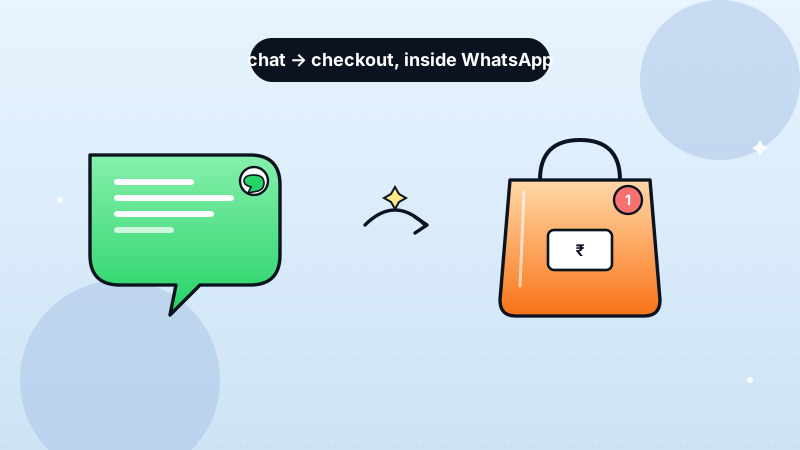
Stage 4 — Checkout & Payment. The customer confirms cart contents, shares their delivery address (often pre-filled from past orders), and pays via a UPI payment link sent in the chat. For most Indian customers, paying by UPI in-chat is near-instant.
Stage 5 — Fulfillment & Re-engagement. Order confirmation, shipping pickup, out-for-delivery, and delivered notifications all flow through WhatsApp automatically. Two weeks later, an abandoned-cart or restock-alert template message re-engages them — at a fraction of the cost of paid ads.
What's the Difference Between WhatsApp Commerce and Traditional E-commerce?
The headline difference is friction. Traditional e-commerce asks the customer to leave their daily life — open a browser, find your site, navigate it, create an account, type their card. WhatsApp commerce asks them to do nothing they're not already doing. The directional comparison below reflects what we typically see in WatEase merchant data (internal benchmark, methodology on request, as of June 2026); actual results vary widely by vertical, price point, and traffic source.
| Metric | Traditional E-commerce | WhatsApp Commerce |
|---|---|---|
| Conversion rate | Lower | Typically higher |
| Cart abandonment | Higher | Typically lower |
| Customer acquisition cost (India) | Higher | Typically lower |
| Repeat purchase rate | Lower | Typically higher |
| Average response time | Slower (email-paced) | Near-instant in chat |
| Setup cost | ₹50,000 - ₹2,00,000/mo | ₹1,000 - ₹5,000/mo |
| Marketing open rate | Lower (SMS/email) | Typically far higher |
For a deeper teardown of these economics, see WhatsApp vs Website E-commerce.
WhatsApp commerce, quoted to your business
Set up in minutes with guided onboarding. 0% markup on WhatsApp messages.
Get a quote →Why Is WhatsApp Commerce Growing So Fast?
WhatsApp commerce is the fastest-growing channel in emerging markets because four trends are reinforcing each other.
1. Mobile-first behaviour is now mainstream. Tier-2 and tier-3 buyers in India, Brazil, and Southeast Asia were never comfortable on desktop e-commerce. They live in messaging apps. WhatsApp meets them where they already are.
2. Meta has made commerce a strategic priority. The Cloud API launched in 2022, native catalogs in 2023, in-chat payments in India in 2024, and AI assistants in 2025. New e-commerce features ship every quarter.
3. UPI has made payments instant. India processes 12+ billion UPI transactions a month (NPCI, 2025). Sending a UPI payment link in a WhatsApp chat is the lowest-friction checkout that has ever existed on a phone.
4. AI agents work. Modern WhatsApp AI agents can handle a large share of routine pre-sales and support queries without a human, making the channel viable at scale even for small teams.
Who Should Use WhatsApp Commerce?
Almost any consumer-facing business in a WhatsApp-dominant market benefits. The fit is strongest when:
- Your customers are mobile-first. D2C brands, hyperlocal retail, food, beauty, and fashion all over-index here.
- Your AOV is between ₹500 and ₹50,000. Below ₹500 the per-message cost eats margin; above ₹50,000 customers often want a sales conversation, which WhatsApp still handles well.
- You sell to repeat buyers. Salons, grocery, pharmacies, and subscription products typically see a higher repeat purchase rate on WhatsApp than on web.
- You run paid acquisition on Meta. Click-to-WhatsApp ads often convert better than click-to-site for consumer goods.
Specific verticals where WhatsApp commerce is already dominant: retail and D2C, restaurants, healthcare clinics, jewellery, automobile dealerships, and logistics.
How Do You Start Selling on WhatsApp Commerce?
You can be live in under a week. The five-step checklist:
- Pick a provider (a BSP or a Meta Tech Provider) that supports your geography. In India, WatEase handles Meta verification, catalog, automation, and payments end-to-end without a developer.
- Verify with Meta. Submit your company entity, website, and a phone number for the WhatsApp Business Account. Your provider runs this for you — typically 1-3 business days.
- Build your catalog and welcome flow. Upload products (or sync from Shopify / WooCommerce), write a welcome message, and configure one abandoned-cart recovery flow.
- Connect payments. Wire up UPI, Razorpay, PhonePe, or Paytm so payment links generate automatically inside the chat.
- Drive traffic. Add a WhatsApp button to your website, run click-to-WhatsApp ads, put your wa.me link on packaging and email signatures, and start a referral program.
A more detailed walk-through lives in How to Create a WhatsApp Store.
What Are the Common Mistakes to Avoid?
Most WhatsApp commerce failures share one of four causes. Skip them.
Mistake 1: Treating WhatsApp like SMS. Sending unsolicited promotions kills your sender quality rating and gets your number throttled by Meta. Always collect opt-in consent, use Meta-approved templates, and respect 24-hour conversation windows.
Mistake 2: Skipping automation. Manually replying to every "what's your price" message does not scale past ~50 conversations a day. Set up a chatbot or AI agent before you start marketing.
Mistake 3: A weak catalog. Blurry images, missing prices, and 500-character descriptions kill conversion. WhatsApp catalog tiles are small — your hero image and first 80 characters do most of the work. See WhatsApp catalog best practices.
Mistake 4: Ignoring measurement. Without funnel analytics (message → catalog view → added to cart → paid) you cannot tell what's working. Pick a provider that exposes proper conversion reporting from day one.
What's Next for WhatsApp Commerce?
The 2026-2027 roadmap is converging on three themes: deeper AI (autonomous agents that handle complex multi-turn pre-sales conversations), richer in-chat checkout (no more redirects to payment-link pages — full native payment inside WhatsApp), and commerce-first ad formats (Meta's click-to-WhatsApp ads will soon support direct add-to-cart from the ad creative).
Brands that establish their WhatsApp commerce presence now will own the customer relationship before these features go mainstream. The cost of waiting is paying meaningfully more in acquisition costs to chase the same customer on Google or Meta ads driving to a website.
Ready to Launch WhatsApp Commerce?
WhatsApp commerce is among the most efficient direct-to-consumer channels in emerging markets. The infrastructure is mature, the customer behaviour is built in, and the unit economics are typically far better than traditional e-commerce.
Sign up for WatEase to launch your WhatsApp store in under a week — catalog, automation, payments, and AI in one dashboard. Or read the deeper WhatsApp Business Platform guide to understand the technical backbone.
For the canonical reference, see the official WhatsApp Business Platform documentation. And if you also want your WhatsApp commerce content to surface in Google AI Overviews and ChatGPT citations, our Answer Engine Optimization (AEO) guide covers the structured-content patterns that pair well with WhatsApp-led commerce.