Indian businesses face a critical decision in 2026: invest in a traditional ecommerce website, build a WhatsApp store, or do both. The answer depends on your business size, customer base, and growth goals. This guide presents real data comparing both channels so you can make an informed decision. If you do go website-first (or both), our SEO playbook for Indian D2C brands covers the full organic-search stack — from keyword research to schema and Core Web Vitals.
How Do WhatsApp Stores Compare to Websites on Cost?
WhatsApp stores typically cost far less than traditional ecommerce websites when you factor in development, maintenance, and ongoing operational expenses — the indicative ranges below show why. For budget-conscious Indian businesses, this difference is often decisive.
Traditional ecommerce website costs:
| Cost Component | Range (INR) |
|---|---|
| Design and development | 50,000 - 3,00,000 |
| Domain and hosting (annual) | 5,000 - 24,000 |
| SSL certificate (annual) | 1,000 - 10,000 |
| Payment gateway integration | 10,000 - 30,000 |
| Maintenance and updates (monthly) | 5,000 - 20,000 |
| SEO and marketing (monthly) | 10,000 - 50,000 |
| Year 1 total | 1,50,000 - 7,00,000+ |
WhatsApp store costs:
| Cost Component | Range (INR) |
|---|---|
| Platform subscription (monthly) | 2,000 - 10,000 |
| WhatsApp Business API charges | Based on conversation volume |
| Catalog setup | Usually included |
| Year 1 total | 30,000 - 1,50,000 |
The cost advantage of WhatsApp stores is clear, but cost alone should not drive the decision. The real question is which channel delivers better returns for your specific business. Tell us your use case and we quote a WatEase plan that fits your budget.
Which Channel Has Better Conversion Rates for Indian Customers?
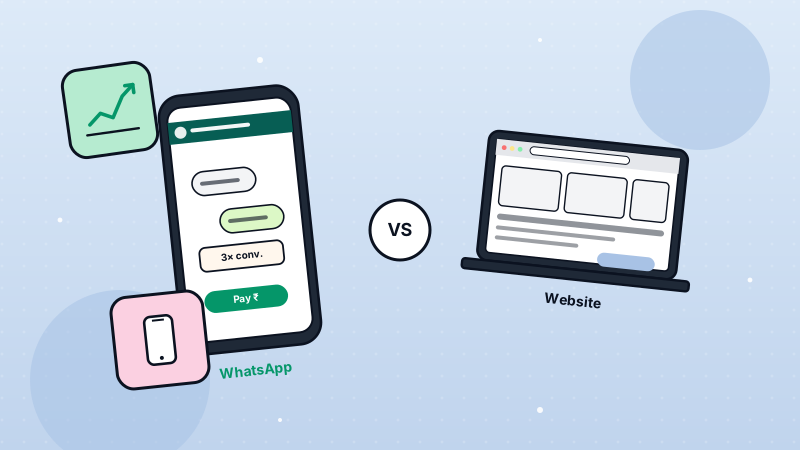
WhatsApp stores typically deliver higher conversion rates than traditional websites because conversational commerce eliminates the friction points that cause Indian customers to abandon purchases.
Directional patterns we see (WatEase internal benchmark, methodology on request, as of June 2026 — your results will vary):
- Typical Indian ecommerce website conversion rates sit in the low single digits
- WhatsApp commerce conversations tend to convert at a noticeably higher rate
- Cart abandonment on websites is generally high (a large share of started carts go unconverted)
- Order abandonment on WhatsApp tends to be meaningfully lower
Why WhatsApp converts better in India:
- No account creation: Indian customers hate creating accounts. WhatsApp eliminates this step entirely — your phone number is your identity
- Instant doubt resolution: On a website, a confused customer leaves. On WhatsApp, they ask a question and get an answer in seconds
- Trust through conversation: Indian buyers, especially in tier-2/3 cities, prefer talking to a person (or a smart chatbot) before purchasing. WhatsApp enables this naturally
- Payment simplicity: Sending a UPI link in a WhatsApp chat converts better than a multi-step website checkout with address forms and payment page redirects
- Vernacular comfort: Customers can type in Hindi, Hinglish, or any regional language. Websites rarely offer this flexibility
As an illustrative example, consider a home decor business in Jaipur that tested both channels simultaneously for three months. Its WhatsApp store converted at a multiple of its website rate, and that gap translated into a substantial lift in monthly revenue. Outcomes like this are not guaranteed and depend heavily on category, pricing, and how the channel is run.
What Do Indian Customers Actually Prefer — Websites or WhatsApp?
Indian customers increasingly prefer WhatsApp for transactions, especially in categories where trust, personalization, and quick communication matter more than browsing large catalogs.
What the broader shift in Indian consumer behaviour looks like (directional — these are patterns, not measured figures):
- A large share of Indian consumers have messaged a business on WhatsApp recently
- Many prefer WhatsApp over email for business communication
- A significant portion would rather order through WhatsApp than download a new shopping app
- A meaningful number have made at least one purchase directly through WhatsApp
Categories where WhatsApp wins decisively:
- Fashion and apparel (personalized recommendations matter)
- Jewelry and accessories (trust and conversation-driven purchases)
- Local food and grocery (repeat orders, convenience)
- Services (salon appointments, repairs, consultations)
- D2C brands with focused product lines
Categories where websites still hold an edge:
- Large-catalog retailers (500+ products need structured browsing)
- Price-comparison shoppers (who compare across multiple sites)
- B2B procurement (complex orders with documentation needs)
- Businesses relying heavily on organic search traffic
The trend is clear: for relationship-driven, repeat-purchase businesses, WhatsApp is becoming the preferred channel. For discovery-driven, first-time purchases, websites still play an important role.
Run your business on WhatsApp with WatEase
Set up in minutes with guided onboarding. 0% markup on WhatsApp messages.
Get started →Want a plan sized to you? Get a quote
When Should You Choose a WhatsApp Store Over a Website?
Choose a WhatsApp store as your primary channel when your business relies on repeat customers, personal relationships, and quick transactions rather than large-scale discovery and catalog browsing.
A WhatsApp store is the right choice if:
- Your product catalog has fewer than 100 items
- Most of your sales come from repeat customers
- Your average order involves customer questions or customization
- Your target audience is in tier-2/3 cities or semi-urban areas
- You have limited budget for technology investment
- Your business is local or regional rather than national
- Personal recommendation drives most of your sales
A traditional website is the better choice if:
- You have hundreds or thousands of products that need search and filtering
- Organic search (Google) is your primary customer acquisition channel
- You sell nationally or internationally
- Your product does not require explanation or conversation
- You need advanced analytics and A/B testing capabilities
The hybrid approach (recommended for most):
The smartest Indian businesses in 2026 are using both — but allocating resources wisely. They maintain a lightweight website or landing page for SEO and credibility, with prominent click-to-WhatsApp buttons that route interested customers to their WhatsApp store for the actual purchase conversation.
This hybrid model captures search traffic through the website and converts it at WhatsApp's higher rate. Get started with WatEase to build this integrated approach.
How Do You Migrate From a Website-Only Model to Include WhatsApp Commerce?
Migrating to include WhatsApp commerce alongside your existing website is a low-risk, high-reward process that most businesses complete within one to two weeks.
Week 1 — Setup and integration:
- Sign up for a WhatsApp Business API platform like WatEase
- Create your product catalog on WhatsApp using your existing website product data
- Set up automated order flows — greeting, catalog sharing, order confirmation, payment
- Add click-to-WhatsApp buttons on your website's product pages, homepage, and contact page
- Configure WhatsApp click-to-chat ads on Facebook and Instagram
Week 2 — Customer migration and optimization:
- Announce WhatsApp ordering to your existing customer base via email and SMS
- Offer a launch discount (10-15% off) for first WhatsApp orders to drive trial
- Add your WhatsApp number to all physical touchpoints — packaging, receipts, store signage
- Monitor order flow and optimize response templates based on common customer queries
- Set up automated abandoned cart recovery for WhatsApp conversations
Metrics to track after migration:
- WhatsApp order volume as percentage of total orders
- Conversion rate comparison: website vs WhatsApp
- Customer satisfaction scores by channel
- Average response time on WhatsApp
- Repeat purchase rate by channel
Businesses that follow this migration path often see WhatsApp grow into a substantial share of total orders within the first few months, frequently with healthier margins thanks to lower customer acquisition costs. The pace and size of that shift vary by business.
What Does the Future of Indian Ecommerce Look Like — WhatsApp or Websites?
The future of Indian ecommerce is conversational, and WhatsApp is leading that shift. However, websites will not disappear — they will evolve to serve different functions in the customer journey.
Conversational commerce (WhatsApp, Instagram DMs, and similar channels) is widely expected to account for a growing share of Indian ecommerce transactions over the next few years, rising from a smaller base today. The exact size of that shift is uncertain and depends on which forecast you read.
Key trends shaping this future:
- AI-powered conversations: Chatbots on WhatsApp are becoming sophisticated enough to handle complex product queries, size recommendations, and even styling advice
- WhatsApp Payments integration: As WhatsApp Pay gains adoption in India, the entire purchase journey — discovery, selection, payment — will happen within a single app
- Voice commerce: WhatsApp voice messages are increasingly being used for orders, especially in markets where typing in regional languages is difficult
- Catalog evolution: WhatsApp's catalog capabilities are expanding to support larger inventories with search and filter features
The businesses that will thrive are those building presence on both channels today. Start with a WhatsApp store through WatEase while maintaining your website for search visibility. This balanced approach ensures you capture customers regardless of their preferred shopping method.
Tell us your use case on our pricing page and we quote a plan with the right combination of features for your business, and explore our industry-specific solutions to see how businesses like yours are succeeding with WhatsApp commerce in 2026.
For the underlying WhatsApp Business Platform that powers a WhatsApp store, see the official Meta Business Platform documentation. And once you've decided whether to go website-first, WhatsApp-first, or hybrid, our SEO playbook for Indian D2C brands covers how to drive organic search traffic into whichever surface you choose.