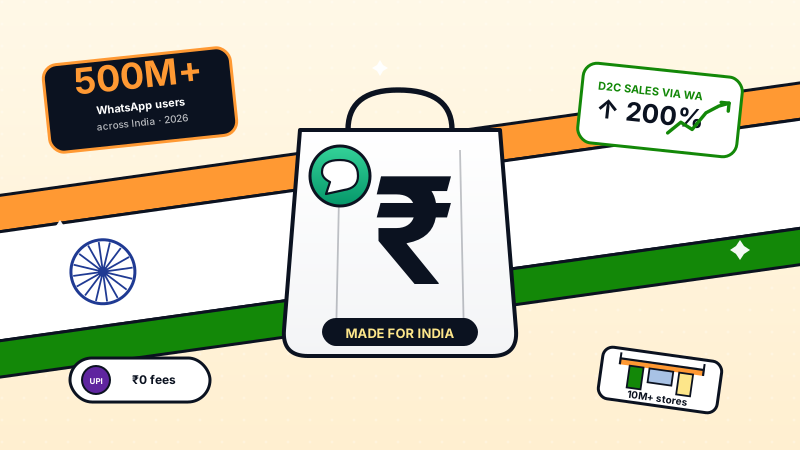
India's retail landscape is undergoing a massive shift. With over 500 million WhatsApp users in the country (Meta reported 500M+ India WhatsApp users in 2023), retailers who embrace WhatsApp commerce can see meaningful revenue growth. This is not a future prediction — it is happening right now, across cities and towns of every size.
Why Are Indian Retailers Turning to WhatsApp for Sales?
Indian retailers are choosing WhatsApp because it meets customers exactly where they already spend their time. Unlike traditional ecommerce platforms that require app downloads and account creation, WhatsApp removes all friction from the buying journey.
The behavior tells a compelling story. WhatsApp messages tend to be opened far more reliably than marketing email or SMS, which often go unread. For Indian retailers, this can translate into higher conversions and repeat purchases.
Several factors drive this shift:
- Zero learning curve: Every smartphone user in India already knows how to use WhatsApp
- Trust factor: Customers prefer buying from a known contact rather than anonymous websites
- Vernacular support: WhatsApp supports all major Indian languages, making it accessible in tier-2 and tier-3 cities
- Low data consumption: WhatsApp works reliably even on slow 2G/3G connections in rural areas
Retailers using platforms like WatEase report that their WhatsApp storefronts generate substantially more repeat orders compared to traditional online channels (in WatEase merchant data, internal benchmark, methodology on request, as of June 2026).
How Are Successful Retailers Setting Up Their WhatsApp Stores?
The most successful Indian retailers follow a structured approach to WhatsApp commerce that combines catalog management, automated responses, and personalized engagement.
Step 1: Build a product catalog. Use the WhatsApp Business API to create a browsable catalog with product images, descriptions, and prices. Organize items into categories so customers can find what they need quickly.
Step 2: Automate the order flow. Set up automated messages for order confirmation, payment links, and delivery updates. This reduces manual work and ensures customers receive instant responses at every stage.
Step 3: Segment your customer base. Group customers by purchase history, location, and preferences. This allows you to send targeted promotions that actually convert rather than generic broadcasts that get ignored.
Step 4: Enable payments. Integrate UPI payment links directly into WhatsApp conversations. Customers can pay without leaving the chat, reducing cart abandonment significantly.
A clothing retailer in Jaipur implemented this exact framework using WatEase's retail solution and reported a substantial jump in monthly revenue over the following months (individual merchant result, not typical of every store).
What Results Are Real Indian Retailers Achieving with WhatsApp Commerce?
Real retailers across India are reporting encouraging results after adopting WhatsApp commerce. The individual cases below are merchant-reported outcomes and are not typical of, or guaranteed for, every store.
Case: Mumbai Fashion Boutique — A women's clothing store in Andheri shifted from Instagram DMs to a structured WhatsApp catalog. Within a few months, they reported a strong volume of monthly orders and a high repeat-customer rate, and said their average order value rose meaningfully through personalized product recommendations sent via WhatsApp.
Case: Bengaluru Electronics Retailer — A multi-brand electronics store used WhatsApp to send warranty reminders, accessory suggestions, and festive offers. They reported a marked improvement in customer retention and a meaningful reduction in customer service calls through automated FAQ responses.
Case: Delhi Grocery Chain — A three-store grocery chain enabled WhatsApp ordering for daily essentials. They reported processing a large daily order volume through WhatsApp alone, with quick average delivery times and high customer satisfaction scores.
Results like these are possible for retailers willing to invest in the right WhatsApp commerce platform and follow proven implementation strategies, though outcomes vary by store, category, and effort.
Run your business on WhatsApp with WatEase
Set up in minutes with guided onboarding. 0% markup on WhatsApp messages.
Get started →Want a plan sized to you? Get a quote
How Can Retailers Handle Catalogs and Inventory on WhatsApp?
Managing catalogs and inventory effectively is the backbone of successful WhatsApp commerce, and it requires the right tools and processes in place.
Start by keeping your catalog updated in real-time. Nothing frustrates a customer more than ordering a product only to learn it is out of stock. Platforms like WatEase sync your inventory automatically so your WhatsApp catalog always reflects actual availability.
Best practices for catalog management include:
- High-quality images: Use clean, well-lit product photos. Retailers who upgrade their product images often see a noticeable lift in inquiry-to-purchase conversion
- Clear pricing: Always display prices in INR with GST details. Ambiguous pricing kills trust
- Seasonal updates: Rotate your featured products based on seasons, festivals, and trends
- Category organization: Group products logically — by type, price range, or use case
- Quick share links: Create shareable catalog links that customers can forward to friends and family
For retailers with large inventories, automated catalog management through the WatEase platform eliminates the manual effort of updating hundreds of products across channels.
What Marketing Strategies Work Best for Retail WhatsApp Commerce?
The most effective WhatsApp marketing strategies for Indian retailers combine broadcast campaigns, personalized messaging, and strategic timing to maximize engagement without overwhelming customers.
Festival campaigns are the single biggest revenue driver. Smart retailers start building anticipation two weeks before major festivals like Diwali, Eid, or Pongal. They send teaser messages, early-bird discounts, and exclusive WhatsApp-only offers that create urgency.
Abandoned cart recovery on WhatsApp tends to convert far better than email reminders. When a customer shows interest in a product but does not complete the purchase, a friendly WhatsApp follow-up within a couple of hours can recover a meaningful portion of abandoned carts.
Loyalty programs delivered through WhatsApp typically see higher participation than app-based programs. Send point updates, exclusive member discounts, and birthday offers directly to customer chats.
User-generated content campaigns where customers share photos of their purchases in exchange for discount codes generate organic reach and social proof. One retailer in Pune reported growing their customer base substantially over a couple of months using this single strategy (individual merchant result, not typical of every store).
The key principle is value-first messaging. Every broadcast should offer something useful — a discount, a tip, or exclusive access. Retailers who follow this principle tend to maintain strong opt-in rates and low unsubscribe rates.
How Do You Get Started with WhatsApp Commerce Today?
Getting started with WhatsApp commerce is simpler than most retailers expect, and many retailers begin seeing returns early, though timelines vary by store and category.
Begin by signing up for a WhatsApp Business API platform that is designed for Indian businesses. Look for features like vernacular support, UPI integration, automated workflows, and catalog management.
Next, migrate your existing customer contacts to WhatsApp with proper opt-in. Send a simple introductory message explaining what customers can expect — product updates, exclusive offers, and easy ordering.
Start small. Pick your top 20 products, create a clean catalog, and test the order flow with a small group of loyal customers. Gather feedback, refine your process, and then scale.
The retailers who succeed are those who treat WhatsApp not as just another sales channel, but as a relationship-building platform. When customers feel valued and heard, they buy more, return often, and refer others.
Indian retail is evolving rapidly, and WhatsApp commerce is leading that evolution. The question is not whether to adopt it — it is how quickly you can get started.
Illustrative channel economics for a mid-sized Indian retailer doing ₹10L/month in online orders (cost figures are typical market ranges; relative repeat-rate is directional, based on WatEase merchant observations — internal benchmark, methodology on request, as of June 2026 — and varies by store):
| Channel | Cost structure | Relative repeat rate | Owns customer data? |
|---|---|---|---|
| Amazon / Flipkart | 12–25% commission per order | Lowest | No (marketplace owns) |
| Custom mobile app | ₹3–10 lakh build + ongoing dev | Moderate (with retention) | Yes |
| Instagram DM (manual) | Free + staff time | Moderate–high | Partial |
| WhatsApp Business API (WatEase) | priced on request + ~₹0.115–₹0.8631 per message (Meta per-message rates as of September 2026 — see Meta's pricing) | Highest | Yes (full) |
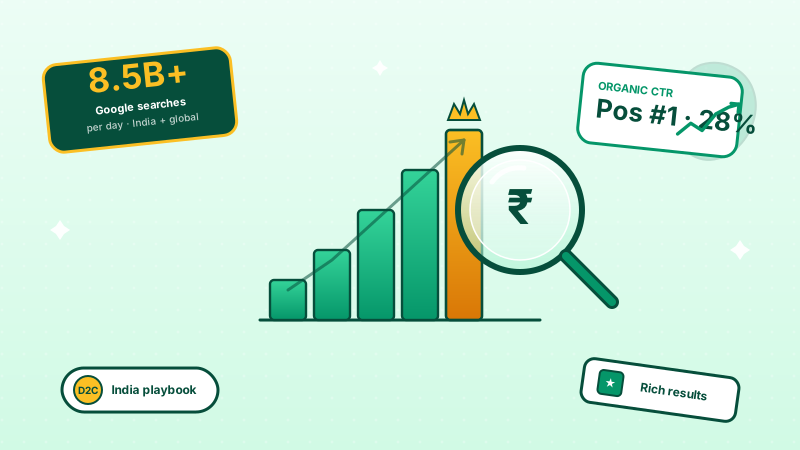
For the underlying API capabilities, see the official WhatsApp Business Platform documentation. If you also drive organic traffic to a brand website, our SEO playbook for Indian D2C brands covers the discovery side of the funnel that complements this conversational layer.