"Should I sell on my own WhatsApp store or list on Amazon and Flipkart?" is one of the most common questions Indian sellers ask — and the honest answer is that they solve different problems. Marketplaces buy you traffic; an owned store buys you margin and customer relationships. This 2026 comparison lays out the real trade-offs so you can choose deliberately, or — as most successful sellers do — use both. If you're still deciding how to launch, start with our guide to creating a free online store in India.
WhatsApp Store vs Marketplace: The Honest Comparison
The two models differ on almost every axis that matters to a seller's bottom line. Here's the head-to-head.
| Factor | WhatsApp store (WatEase) | Marketplace (Amazon/Flipkart) |
|---|---|---|
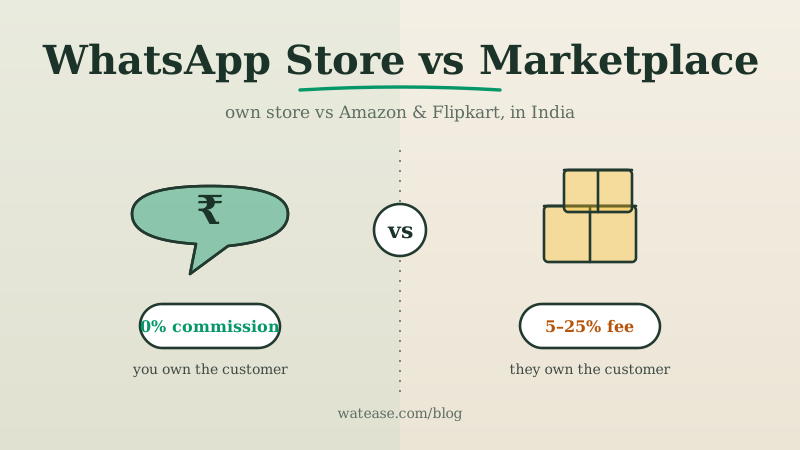
| Platform commission per sale | 0% (Meta/WhatsApp message charges still apply) | Category-dependent commission + fees (see each platform's published fee schedule) |
| Traffic | You drive it | Built-in, large |
| Customer ownership | You own the conversation with the customer | Direct post-sale contact generally restricted (see platform policy) |
| Brand building | Full control of your store and messaging | Brand presence governed by marketplace listing rules |
| Payouts | Standard gateway timelines (UPI near-instant) | Fixed cycle, net of fees & returns |
| Trust for Tier-2/3 buyers | Chat can act as a trust layer | Marketplace brand recognition |
| Best for | Repeat, high-margin, loyal customers | Discovery, first-time buyers |
The takeaway: marketplaces are a discovery channel you rent; a WhatsApp store is an asset you own. Neither is strictly "better" — they're complementary.
Why Do Marketplaces Cost You More Than They Look?
Marketplaces advertise "free to list," but there are recurring per-order costs to factor into your margin as you grow. Three things to weigh:
- Commission and fees — a category-dependent commission on each sale (published in each platform's seller fee schedule; see Amazon Seller Central and Flipkart Seller Hub for current rates as of June 2026), plus closing fees and, if you use their logistics, fulfilment and storage charges.
- Limited direct access to the customer — marketplaces generally restrict direct post-sale customer contact and remarketing; check each platform's current seller policy for the exact terms. By contrast, a WhatsApp store keeps the buyer in a conversation you own.
- Brand presence is governed by listing rules — buyers often recall the marketplace they bought on, and your branding within a listing follows the marketplace's rules. A WhatsApp store gives you full control of your store page and messaging, which makes building repeat business and loyalty more direct.
None of this means marketplaces are bad — the traffic is real and valuable. But if every sale stays on the marketplace forever, you're acquiring customers you can't easily re-reach instead of building your own base.
What Does a WhatsApp Store Give You That a Marketplace Can't?
A WhatsApp store flips the marketplace model: you trade built-in traffic for ownership, margin, and a direct relationship. For repeat-driven businesses, that's a powerful trade.
- No platform commission — WatEase takes no commission on your sales, so you keep your margin; standard Meta/WhatsApp message charges still apply, and UPI typically settles at a low or near-zero MDR (confirm current MDR with your payment provider).
- You own the customer conversation — every buyer is a contact you can serve, upsell, and bring back (with their consent) through a channel you control.
- Conversation can reduce checkout friction — by keeping payment inside a familiar chat (a UPI link) rather than redirecting to an unknown checkout page, in-chat checkout removes a common drop-off step, which can help with buyers outside metros. See more in our WhatsApp vs website comparison.
- Faster cash flow — payouts arrive on standard gateway timelines, not a marketplace's deferred cycle net of deductions.
The catch is real: you have to bring your own traffic. That's the price of ownership — and it's solvable with social, referrals, and click-to-WhatsApp ads.
Run your business on WhatsApp with WatEase
Set up in minutes with guided onboarding. 0% markup on WhatsApp messages.
Get started →Want a plan sized to you? Get a quote
How Do You Drive Traffic to a WhatsApp Store?
Since the store doesn't come with built-in shoppers, traffic is the one job you own — and it's very doable. Use the channels where your buyers already are.
- Existing contacts — your first orders come from people who already know you; share your store link on WhatsApp status and to your customer list (with consent).
- Social bios and posts — put your store link in your Instagram and Facebook bios and pin product posts.
- Click-to-WhatsApp ads — Meta ads that open a WhatsApp chat let prospects start a conversation in one tap, which can be an effective, high-intent acquisition channel in India.
- Google Business Profile — add your WhatsApp number so local buyers can message you directly.
- Marketplaces as a feeder — fulfil marketplace orders well, then invite those buyers to reorder directly on WhatsApp.
For the full demand-generation playbook, see our WhatsApp marketing campaigns guide.
Should You Use Both? (Yes — Here's How)
The smartest strategy isn't either/or — it's using each channel for what it's best at. Marketplaces find new buyers; your WhatsApp store keeps them.
A proven approach for Indian sellers:
- List on marketplaces for discovery — accept the commission as a customer-acquisition cost.
- Delight on fulfilment — fast shipping, a thank-you note, and your WhatsApp store QR in the package.
- Move repeat buyers to WhatsApp — invite them to reorder directly, where you keep full margin and own the relationship.
- Keep one catalog — a WhatsApp commerce platform like WatEase syncs with Shopify and WooCommerce so your products and inventory stay consistent across channels.
This way you get the marketplace's reach and the owned-channel economics — without choosing permanently. Compare platforms for the owned side in our best WhatsApp commerce platforms in India roundup.
Which Should You Choose to Start?
If you have no audience yet and need orders this week, a marketplace's traffic is the fastest start — but plan from day one to convert those buyers into owned customers. If you already have any audience — social followers, a customer list, a local presence — starting with a WhatsApp store keeps more of each sale, since there's no platform commission deducted (standard Meta/WhatsApp message charges still apply).
For most sellers, the right first move is to open a WhatsApp store (so you have an owned channel from the start) and add a marketplace listing when you want extra discovery. WatEase is priced on request, with a plan customised to your business (standard Meta/WhatsApp message charges still apply on top). Create your WatEase store in under five minutes, and read the official Meta WhatsApp Business Platform documentation for how the underlying platform works.
Notes, methodology & disclaimers
Trademark attribution. The third-party product names, brand names, and logos referenced here (e.g. Amazon, Flipkart, Meta, WhatsApp, Shopify, WooCommerce) are the trademarks or registered trademarks of their respective owners. They are used here solely for identification and honest, factual comparison under nominative fair use, and do not imply any affiliation, partnership, sponsorship, or endorsement. WatEase is an independent product and is not affiliated with, endorsed by, or associated with any of the companies or brands named here. All comparative statements reflect WatEase's understanding of each provider's publicly available information as of the date stated below.
How we compared (methodology). Statements about other platforms are based on each vendor's own publicly available pricing pages, product pages, and documentation, captured as of June 2026 ("Last verified"). "No" means a capability is not native to that platform as publicly listed — it may exist via an integration, a higher tier, or a later release; "Partial" means it is present with the caveats noted alongside. Any percentage or statistic is attributed to its named source and date where shown; where no figure is cited, the point is directional, not a measured benchmark. Competitor prices and features change frequently and may be in another currency — always verify current details on the relevant vendor's own website before deciding. Prices exclude Meta/WhatsApp message charges, which apply to every WhatsApp Business platform. Spotted something out of date? Email support@watease.com and we'll review and correct it within one business day.