The WhatsApp Business Platform is Meta's enterprise messaging stack — built on the WhatsApp Business API — that lets e-commerce brands run product catalogs, automated journeys, payments, and AI agents inside the world's most-used messaging app. For online sellers, it is no longer optional. WhatsApp is the world's most-used messaging app — with far more daily reach than any owned e-commerce app — and the Platform is the only way to actually sell on it at scale.
This guide explains what the Platform is, how it differs from the consumer WhatsApp app and the Business app, what features e-commerce brands actually use, and what it costs.
What Is the WhatsApp Business Platform?
The WhatsApp Business Platform is the commercial tier of WhatsApp built for medium and large businesses. It sits on top of the WhatsApp Cloud API (hosted by Meta) or the on-premises Business API, and provides the building blocks an e-commerce store needs: product catalogs, automated message flows, broadcast templates, payment links, AI agents, and analytics.
Unlike the free WhatsApp Business app — which is designed for single-owner shops messaging from one phone — the Platform supports:
- Multiple agents chatting from a shared inbox without sharing phones
- Automated workflows that fire when an order is placed, payment is received, or shipping starts
- Programmatic broadcasts to thousands of customers via Meta-approved message templates
- Third-party integrations with Shopify, WooCommerce, your ERP, your CRM, your payment gateway
- Programmatic catalog updates so a product change in your inventory system reflects on WhatsApp instantly
A typical Platform deployment looks like this: your store's inventory and order systems push to a provider like WatEase (a Meta Tech Provider; others are Business Solution Providers, or BSPs), the provider talks to Meta's Cloud API, and customers experience a polished commerce flow inside their existing WhatsApp app — no install, no signup, no learning curve.
WhatsApp Business App vs WhatsApp Business Platform: What's the Difference?
The WhatsApp Business app and the WhatsApp Business Platform share a name but solve very different problems. The app is a free mobile tool for the corner store. The Platform is the infrastructure that powers Amazon-tier WhatsApp commerce.
| Capability | Business App (free) | Business Platform (API) |
|---|---|---|
| Concurrent agents on one number | 1 device | Unlimited (shared inbox) |
| Broadcast size | ~256 contacts | Unlimited via templates |
| Automated workflows | Quick replies only | Full automation + AI |
| Catalog size | ~500 products | 10,000+ products |
| CRM / ERP integration | None | REST API + webhooks |
| Order automation | Manual | Programmatic |
| Analytics | Basic chats | Full conversion funnels |
| Cost | Free | Per-message + platform fee |
If you have under 50 messages a day and a single owner-operator, the Business app is fine. The moment you cross 50-100 conversations a day or want to run paid acquisition into WhatsApp, you need the Platform. We cover the full breakdown in WhatsApp Business API vs App.
Why Does Your E-commerce Business Need the WhatsApp Business Platform?
E-commerce brands need the WhatsApp Business Platform because it removes the three biggest barriers in online retail: app install friction, abandoned carts, and customer support cost. Customers are already in WhatsApp every day; the Platform is the only way to put your store in front of them.
1. The reach is unmatched
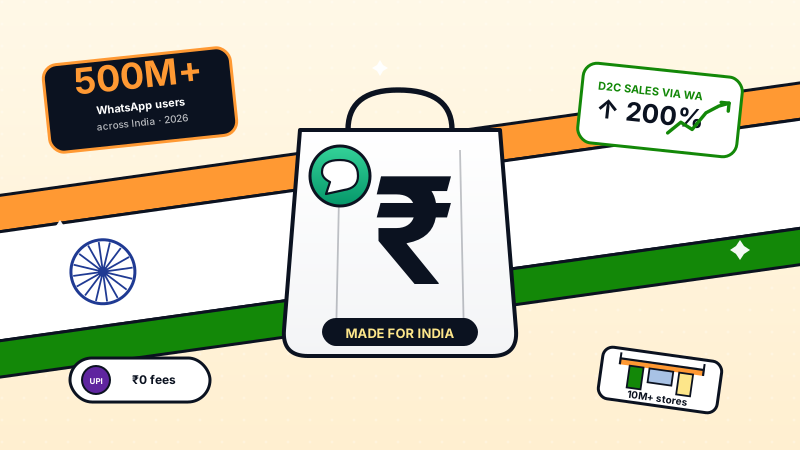
WhatsApp has 2 billion+ monthly active users globally and 500M+ in India alone (Meta, 2025). For comparison, your top-performing native app probably has a few thousand. The Platform lets you reach customers in the channel they spend the most time in — without the steep drop-off that typically comes with asking them to install something new.
2. Conversion rates tend to run higher
WhatsApp checkouts generally convert at a higher rate than a typical web storefront, and in WatEase merchant data the gap is consistently in our favour (internal benchmark, methodology on request, as of June 2026). Three reasons: there's no account creation, no card-entry friction (UPI / payment-link flow takes only a few seconds), and the conversation builds trust before the buy decision. Cart abandonment also tends to fall well below typical web abandonment on WhatsApp.
3. Automation handles support at zero marginal cost
The Platform exposes automated reply rules, chatbot flows, and AI agents that handle order status, return requests, product Q&A, and pre-sales objections without a human. In WatEase merchant data, a large share of customer queries resolve without a live agent (internal benchmark, methodology on request, as of June 2026).
4. Re-engagement is a button, not an ad spend
You already have your customers' phone numbers. With Platform-approved utility and marketing templates, you can re-engage at a fraction of paid-ad CPMs. Open rates on WhatsApp marketing messages typically run far above what email and SMS achieve.
5. Payments happen inside the chat
The Platform supports payment links from UPI, Razorpay, PhonePe, Paytm, and Stripe, embedded directly in the conversation. Customer taps, pays, gets confirmation — all in WhatsApp. No redirect, no checkout page, no abandoned-cart email needed. See WhatsApp payment collection with UPI for the full payment flow.
WhatsApp commerce, quoted to your business
Set up in minutes with guided onboarding. 0% markup on WhatsApp messages.
Get a quote →What Features Does the WhatsApp Business Platform Include for E-commerce?
The Platform's e-commerce surface area breaks into six pillars. A modern provider like WatEase exposes all of them through a single dashboard.
1. Product catalog. Upload products with images, descriptions, prices, and variants. Customers browse the catalog inline in chat, tap to view a product, and add to cart without leaving WhatsApp. See catalog best practices.
2. Conversational checkout. Cart-in-chat, address collection, payment-link generation, and order confirmation — all without a redirect. The customer never leaves the WhatsApp interface.
3. Automated messaging. Welcome flows on first message, order confirmations, shipping updates, delivery notifications, and abandoned-cart nudges fire automatically based on store events.
4. Broadcast campaigns. Send Meta-approved marketing templates to segmented customer lists — birthday offers, restock alerts, festival promos. Reply handling routes back to your shared inbox or an AI agent.
5. AI customer support. AI agents trained on your product catalog and FAQs answer most queries instantly and escalate complex cases to humans.
6. Analytics and attribution. Full funnel reporting: message delivered → read → clicked catalog → added to cart → paid. Track which campaigns drove revenue and which automation flows convert.
How Do You Get Started with the WhatsApp Business Platform?
Getting onto the Platform is a four-step process. End-to-end onboarding through a provider usually takes 1-3 business days.
Step 1: Verify your business with Meta. You need a registered company entity, a website or social presence, and a phone number not currently active on WhatsApp Business app. Providers like WatEase handle the Meta Business Manager setup, Facebook Business Verification, and WhatsApp Business Account creation for you.
Step 2: Choose a provider. You technically can build directly on the Cloud API, but most brands pick a provider — a Business Solution Provider (BSP) or a Tech Provider — because it bundles the dashboard, catalog editor, automation builder, and analytics that the raw API doesn't include. WatEase is a Meta Tech Provider focused on Indian e-commerce; other options exist for different geographies.
Step 3: Set up your catalog, automations, and payment integrations. Upload products (or sync from Shopify / WooCommerce), build a welcome flow, configure abandoned-cart recovery, and connect your payment gateway. A typical store goes live in a day on WatEase.
Step 4: Drive traffic. Add a click-to-WhatsApp button on your website, run click-to-WhatsApp ads on Facebook and Instagram, and put your WhatsApp link on packaging and email signatures. The Platform's conversion math means even modest traffic drives meaningful revenue.
What Does the WhatsApp Business Platform Cost?
The Platform has two cost layers: Meta's per-message charge, and the provider's software subscription. Both scale with your message volume, which is generally cheaper than equivalent SMS or email automation.
| Cost layer | Pricing (India, 2026) |
|---|---|
| Meta — marketing messages | ~₹0.8631 per message (as of September 2026) |
| Meta — utility messages | ~₹0.115 per message |
| Meta — service messages | ~₹0.115 per message from 1 October 2026 (utility rate) |
| Platform subscription | priced on request |
| Payment gateway charges | 1.5% - 2% per transaction |
A small store doing 5,000 monthly conversations typically pays Meta around ₹1,000-2,000 plus a platform fee — well under what equivalent email + SMS volume would cost, and typically with stronger conversion. Compare to the full WhatsApp commerce cost breakdown for India.
See WatEase pricing: tell us your use case and we quote a plan that fits.
When Is the WhatsApp Business Platform Not the Right Choice?
The Platform is overkill in a few specific cases. Be honest with yourself:
- You handle under 50 conversations a day — the free Business app is plenty.
- You sell B2B with sales cycles measured in months — email and CRM are better fits than chat.
- You're outside Meta's supported regions — coverage is global but a few countries have restricted commerce features.
- Your customers are not on WhatsApp — if your buyers are primarily in markets where iMessage, WeChat, or Line dominate, prioritize those first.
For Indian D2C, retail, food, beauty, healthcare, and SaaS brands selling to SMBs, the Platform is essentially mandatory by 2027. The brands that establish their channel now will own the customer relationship before the competition catches up.
Ready to Launch on the WhatsApp Business Platform?
The WhatsApp Business Platform turns the world's most-used messaging app into a complete e-commerce surface — catalog, checkout, support, and re-engagement in one place. For online sellers, the question is not whether to adopt it but how fast.
Sign up for WatEase to onboard onto the Platform in 1-3 days with a dashboard for catalog, automation, payments, and AI — no developer required. Or talk to our team on WhatsApp to see if your business is a fit.
For the canonical Meta reference on the WhatsApp Business Platform's features, limits, and pricing, see the official WhatsApp Business Platform documentation. If you're planning a discovery layer alongside the Platform, our SEO playbook for Indian D2C brands covers how to drive organic search traffic into a WhatsApp commerce funnel.